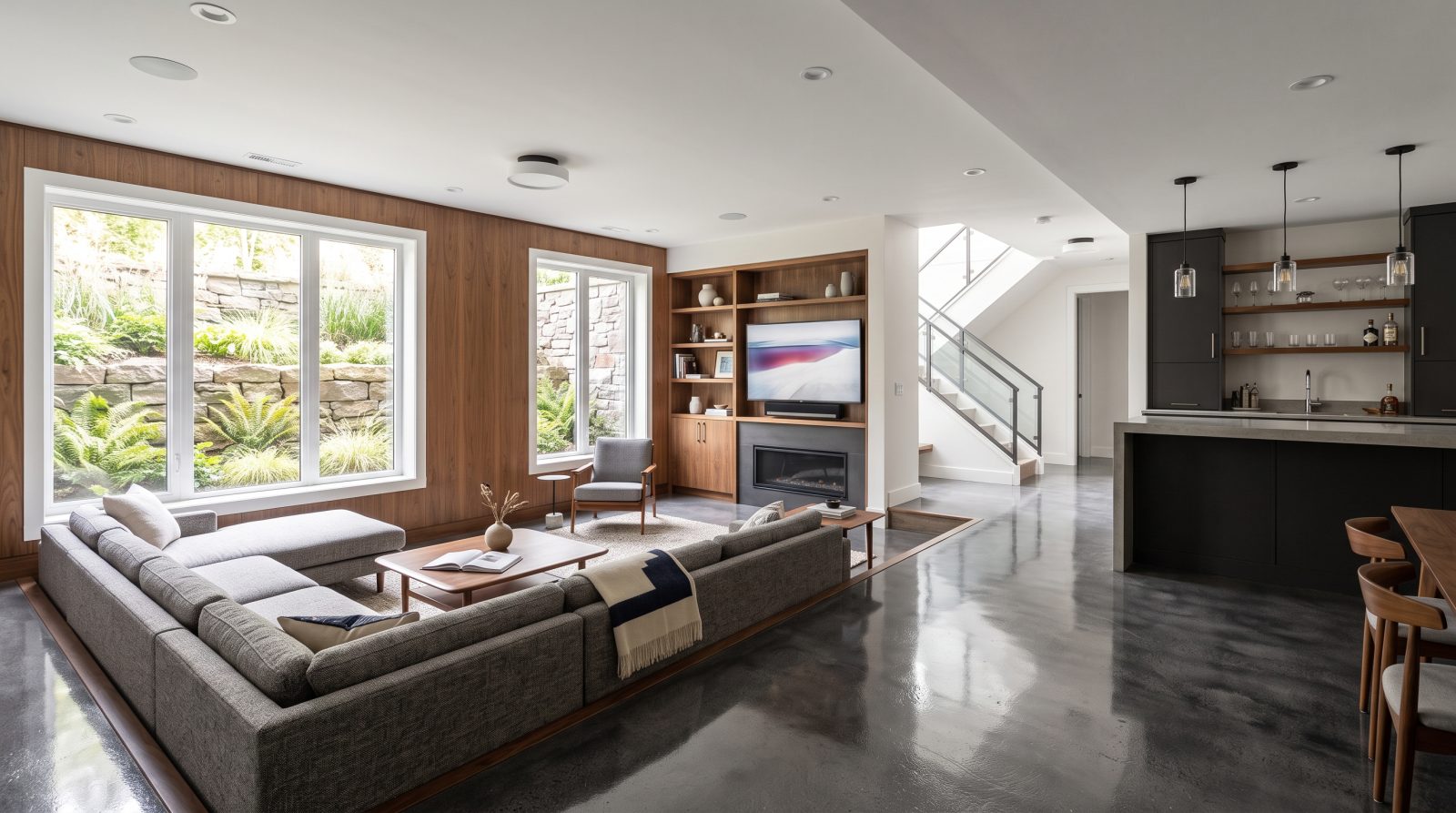
What is basement floor coating, and how is it different from a garage?
Basement floor coating uses the same family of resins as garage coatings, but interior and below-grade slabs behave differently, so the approach changes. A garage usually sits on grade with good airflow and sheds water quickly. Basements and lower levels are partially or fully below grade, which means cooler concrete, slower drying, and a higher chance of moisture pushing up through the slab from the soil. A coating that ignores that moisture will eventually bubble, peel, or cloud, no matter how good the resin is.
Because of this, a basement system is built around moisture management first and appearance second. That can mean a moisture-tolerant primer, a vapor-mitigating base coat, or simply waiting for the slab to test dry before anything is applied. The finish coat can still be a full chip floor, a metallic, or a clean solid color, just like a garage, but the layers underneath are chosen for the conditions below your house.
- Epoxy: a thick build coat that bonds well to prepared concrete and forms the body of most floors
- Polyaspartic: a fast-curing, abrasion- and yellowing-resistant topcoat that also cures in cooler temperatures
- Hybrid systems: an epoxy base for thickness paired with a polyaspartic topcoat for durability and a quicker return to service
Why moisture testing comes before any coating
Below-grade concrete is in constant contact with soil, and soil holds water. Even a slab that looks bone-dry can carry vapor that rises and pushes against the underside of a coating. When that vapor pressure has nowhere to go, it lifts the coating off the concrete in blisters or leaves a hazy, milky look. This is the most common reason interior coatings fail, and it is almost always preventable.
Before quoting a finish, a calcium chloride test or relative humidity probe gives a real reading of how much moisture is moving through the slab. If the numbers are high, the fix is a vapor-mitigating primer rated for that level, or addressing a drainage or grading issue outside first. Skipping this step to save a day is the fastest way to end up recoating later. We would rather test, tell you what the slab is actually doing, and recommend the system that matches it.
- Calcium chloride test: measures moisture vapor emission over roughly 60 to 72 hours
- Relative humidity probe: reads moisture deeper inside the slab for a more complete picture
- South Bay slabs over expansive clay soils, or older slabs poured without a vapor barrier, can drive seasonal moisture up through the floor, which makes testing especially worthwhile
How we prepare the concrete
Coatings do not stick to smooth, sealed, or contaminated concrete; they stick to a clean, open, profiled surface. Proper preparation is the difference between a floor that lasts many years and one that flakes underfoot. For interior slabs we mechanically profile the concrete, usually by diamond grinding, which opens the surface, removes old paint or sealer, and gives the resin something to grip. We typically aim for a concrete surface profile in the CSP 1 to 3 range, depending on the system being applied.
Grinding also lets us see and treat what is actually in the floor. Cracks are chased out and filled with a structural repair material, spalled areas are patched, and any oil or efflorescence is dealt with before priming. On interior jobs we use dust-controlled grinding equipment with vacuum collection to keep the rest of the home clean, which matters far more in a finished basement than in an open garage.
- Diamond grind to remove old coatings, sealers, and laitance and open the surface
- Fill cracks and patch spalls so the finished floor is smooth and sealed edge to edge
- Vacuum-assisted, dust-controlled prep to protect the rest of the house
- Final clean so no dust or debris is trapped under the first coat
Cure times, thickness, and what to expect during the job
Most residential basement coatings are applied in the range of roughly 8 to 20 mils for a standard epoxy-and-topcoat system, with full broadcast chip or specialty systems running thicker. The exact build depends on the product and the look you want. What matters to you day to day is the cure schedule: when you can walk on it, when furniture can come back, and when it is fully hardened.
Polyaspartic topcoats are popular for basements partly because they cure quickly even in the cooler temperatures common below grade. As a general guide, epoxy base coats are often walkable in about 12 to 24 hours, while polyaspartic topcoats can be light-foot-ready in a matter of hours. Full chemical cure, the point at which the floor reaches maximum hardness and resistance, typically takes several days. Temperature and humidity in the space affect all of these times, which is another reason interior conditions get checked before scheduling.
These ranges are general industry guidance, not a promise for your specific floor. The product data sheet for the system we use, plus the actual temperature and humidity in your basement on installation day, set the real timeline, and we will walk you through it before we start.
Finishes that work well in basements and interior rooms
Because basements and lower levels often double as living, laundry, workout, or storage space, the finish should be both durable and pleasant to be around. Full chip (flake) systems are a strong default: the broadcast vinyl flakes add texture for slip resistance, hide minor imperfections, and create a finished look that holds up to traffic. Solid-color floors give a clean, modern feel and are easy to keep tidy. Metallic finishes can turn a basement family room or home gym into a real feature space.
Slip resistance is worth a specific conversation for interior floors, especially around laundry areas, utility sinks, or any spot that may get wet. A fine aggregate or a textured flake broadcast can be added to the topcoat to improve grip without making the floor hard to clean. We will match the finish and the texture to how you actually use the room.
- Full chip / flake: textured, forgiving, and finished-looking; great for multi-use basements
- Solid color: clean and simple, easy to wipe down, good for laundry and utility rooms
- Metallic: a high-end decorative look for finished living spaces
- Added slip texture for damp-prone zones like laundry and utility areas
Keeping a coated interior floor looking new
A finished resin floor is one of the lowest-maintenance surfaces you can put in a basement. Day to day, dust-mopping and the occasional damp mop with a pH-neutral cleaner keeps it clean. Spills wipe up rather than soaking in, and the sealed surface means no more concrete dust drifting through the room. Avoid harsh acidic cleaners, and put soft pads under heavy items to protect the finish.
A coated floor also gives you an early warning system for water problems. Because the surface is sealed, any new water intrusion shows up as a puddle on top instead of quietly wicking into the slab, so you notice and address drainage or plumbing issues sooner. If you ever do see persistent moisture, it is a sign to look at grading, gutters, or drainage outside the home, the same root causes that matter for any below-grade space.