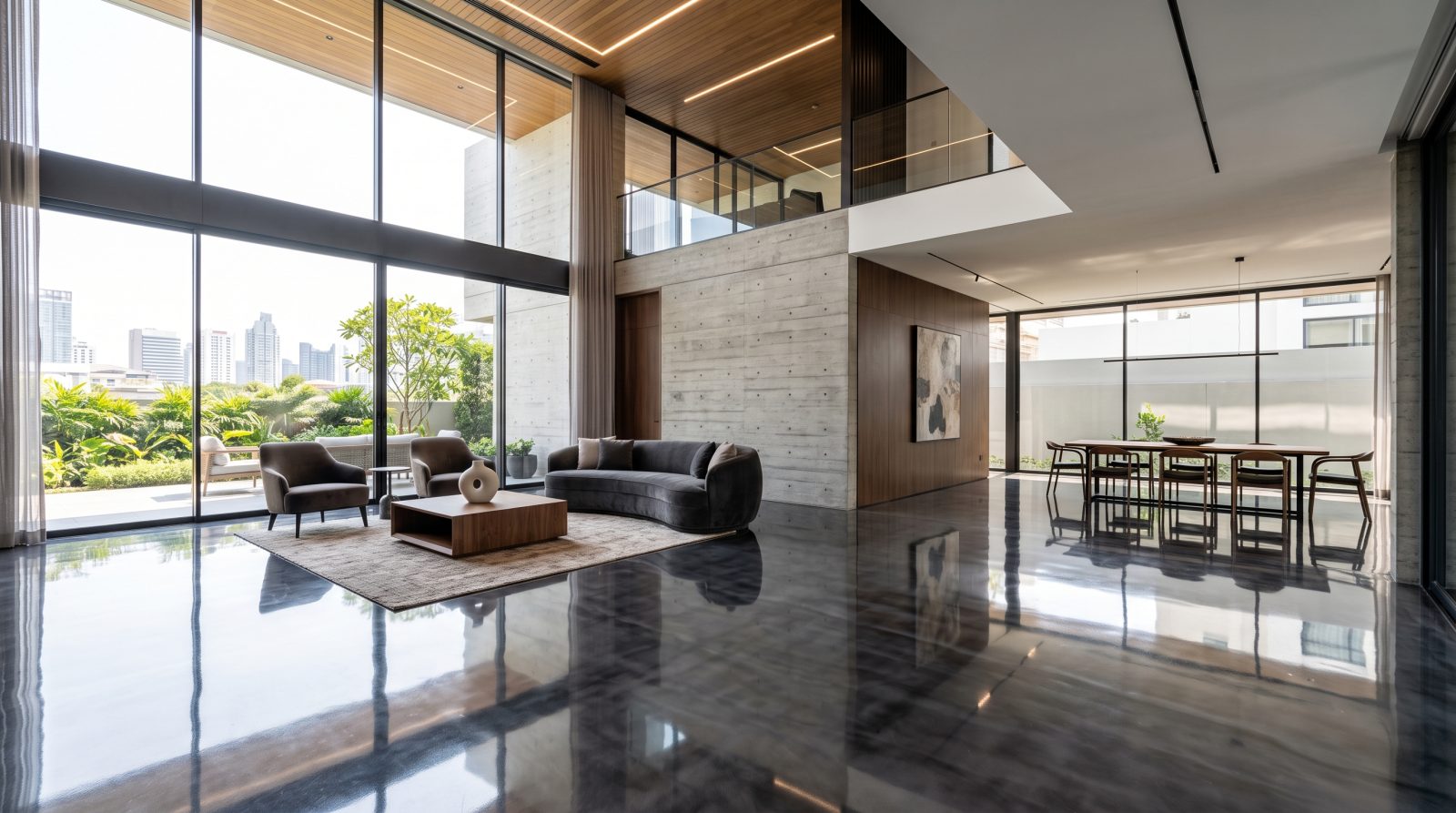
Why does epoxy flooring sometimes feel slippery?
Epoxy itself isn't inherently slippery. What people notice is the finish: a poured, self-leveling epoxy with a high-gloss clear coat is by design a very smooth, nearly seamless surface. Smooth plus shiny reads as 'slick' to the eye and, under the wrong conditions, underfoot too. The same floor with a textured topcoat can feel completely secure.
The real culprit is almost always a thin film between your shoe and the floor. Dry, clean, high-gloss epoxy gives reasonable grip for normal walking. Add water, automotive oil or grease, fine dust, or tracked-in pollen, and that smooth surface offers very little for a shoe sole to bite into. This is why a garage epoxy can feel fine in summer and surprisingly slick the morning after a winter rain when a car drips onto it.
Two other factors matter. First, gloss level: the higher the sheen, the smoother the wear layer tends to be, so a satin or matte finish usually feels a touch more secure than a mirror gloss even before any additive. Second, footwear and floor temperature: smooth-soled shoes and socks slide far more than rubber-soled work boots, and a cold, condensation-prone slab (common in unheated South Bay garages on damp mornings) can develop a light moisture film you can't always see.
The key takeaway is that slip resistance is something the installer controls during the topcoat stage. It is not a fixed property you're stuck with. Decide how the room will be used, and the finish can be built to match.
What actually controls slip resistance? Coefficient of friction, texture, and gloss
Slip resistance is measured as a coefficient of friction, essentially how much grip a surface provides. The industry often cites a dynamic coefficient of friction (DCOF) of around 0.42 or higher as a common benchmark for surfaces expected to get wet, such as the value referenced in tile standards (ANSI A137.1). Epoxy floors aren't tile, but the same principle applies: the more micro-texture a surface has, the higher its wet traction.
Three levers determine where your floor lands. Texture is the biggest one. Adding a fine aggregate into the topcoat creates thousands of tiny high points that break up water film and give a shoe sole something to grip. Aggregate size controls how aggressive that texture feels, from a barely-there satin grip to a coarse, sandpaper-like surface for wet industrial use.
Gloss is the second lever. A flatter sheen scatters light and tends to come with a slightly less polished wear surface, so matte and satin systems generally feel more secure underfoot than full gloss, all else equal. The third lever is the coating chemistry of the wear layer itself: some clear topcoats are formulated to be grippier, or pair better with anti-slip additives, than others.
It's worth being honest about trade-offs. More texture means more grip but also a surface that's slightly harder to mop perfectly clean and that can feel rough on bare feet or knees. The goal isn't maximum grit everywhere. It's matching the texture to the room so a garage or entry is safe while a finished basement or showroom stays smooth and easy to clean.
Anti-slip options: additives, flake, and quartz systems
There are several proven ways to make an epoxy floor more slip-resistant, and they can be combined. The most common is broadcasting or mixing an anti-slip aggregate into the final clear coat. The choice of aggregate changes how the floor feels and performs:
- Fine silica sand or polymer grit: mixed into the topcoat for a subtle, satin-like traction. Comfortable for living spaces and light garages; the texture is felt more than seen.
- Aluminum oxide: a harder, more durable aggregate that holds its grip longer under heavy traffic and abrasion. A good middle ground for working garages and shops.
- Coarse or graded aggregate broadcast: a heavier texture for genuinely wet or oily areas such as wash bays, ramps, and commercial kitchens, where maximum traction matters more than smoothness.
- Decorative flake (chip) systems: the broadcast vinyl flakes plus a clear topcoat already create a slightly textured, less mirror-like surface, which improves grip versus a plain smooth pour. Adding a fine aggregate on top boosts it further.
- Quartz broadcast systems: colored quartz granules troweled or broadcast into the resin produce a naturally textured, durable, slip-resistant surface popular in commercial and wet environments.
How installers build slip resistance into the floor
Anti-slip is added during the topcoat (wear coat) stage, after the base color or flake layer has cured. There are two main methods. In the broadcast method, the installer applies the clear coat and, while it's still wet, casts the aggregate across the surface so it embeds and locks in; a second clear coat can then lock everything down. In the mix-in method, the aggregate is stirred directly into the topcoat before rolling it on, which spreads grip evenly through the film.
Surface preparation still drives durability. A long-lasting epoxy floor is typically installed over a properly profiled slab, usually diamond-ground or shot-blasted to open the concrete pores so the coating bonds mechanically. The concrete also needs to be tested for moisture; a slab that's pushing vapor from below can cause delamination no matter how good the coating is. Anti-slip texture only stays effective if the whole system stays bonded.
Cure times matter for both safety and scheduling. As a general guide, many epoxy systems are dry to the touch within roughly 12 to 24 hours, ready for foot traffic in about 24 to 72 hours, and fully cured for vehicle traffic and full chemical resistance in around 5 to 7 days, depending on the product and conditions. Until full cure, the surface can be softer and behave differently underfoot, so it's worth keeping the area clear.
Conditions during install affect the result, too. Most epoxies are formulated to be applied within a moderate temperature range (commonly around 50 to 90F) with controlled humidity, because cold or damp conditions slow cure and can affect the finish. In the South Bay's mild but sometimes damp, coastal-influenced climate, a careful installer watches morning humidity and slab temperature so the topcoat, and the anti-slip texture in it, sets evenly.
Choosing the right anti-slip level for each space
The right amount of texture depends entirely on the room. Over-texturing a clean, dry interior makes it harder to mop and rough on bare feet; under-texturing a wet garage creates a real fall risk. Here's a practical way to think about it room by room:
- Residential garages: a fine-to-medium aggregate is usually ideal. It handles tracked-in rain, the occasional oil drip, and washing the car without feeling harsh, which suits most South Bay two-car garages.
- Entryways, ramps, and steps: these get wet and are higher-consequence, so lean toward more aggressive grip. Edges and inclines are where slips most often happen.
- Patios and outdoor-adjacent areas: anywhere exposed to rain or hose-down should be on the grippier end of the scale.
- Basements, gyms, and laundry or utility rooms: a medium texture balances comfort with safety around moisture sources.
- Living areas, showrooms, and finished interiors: a smooth satin or light fine-grit finish keeps the look clean and the floor easy to maintain, since these stay mostly dry.
- Commercial wet zones such as kitchens, wash bays, and shops: the coarsest practical aggregate, prioritizing traction and meeting whatever wet-traction expectations apply to the space.
Keeping an epoxy floor safe over time (maintenance)
Even a well-textured anti-slip floor loses traction if it's dirty. The single biggest cause of an unexpectedly slippery epoxy floor is a film of dust, oil, or soap residue sitting on top of the texture. Routine cleaning is what keeps the grip you paid for working.
Day to day, sweep or dust-mop to remove grit, and wipe up spills, oil, and water promptly. Standing liquid is what turns any smooth surface slick. For deeper cleaning, a damp mop with a pH-neutral cleaner is usually enough; harsh degreasers and heavy soaps can leave a slippery residue if not rinsed well, which ironically makes a clean-looking floor more slippery.
Over years of heavy use, the anti-slip aggregate and clear coat slowly wear, especially in tire tracks and high-traffic lanes. When traction starts to drop noticeably, a fresh anti-slip topcoat can usually be applied over a properly prepped existing floor to restore grip without redoing the whole system. If you're ever unsure whether your floor is wearing thin or just needs a good cleaning, it's a quick thing to have looked at.
If you're weighing finishes or want a recommendation for how you actually use your space, give us a call and we can walk through the right anti-slip level, the maintenance it'll need, and a realistic estimate for your floor.