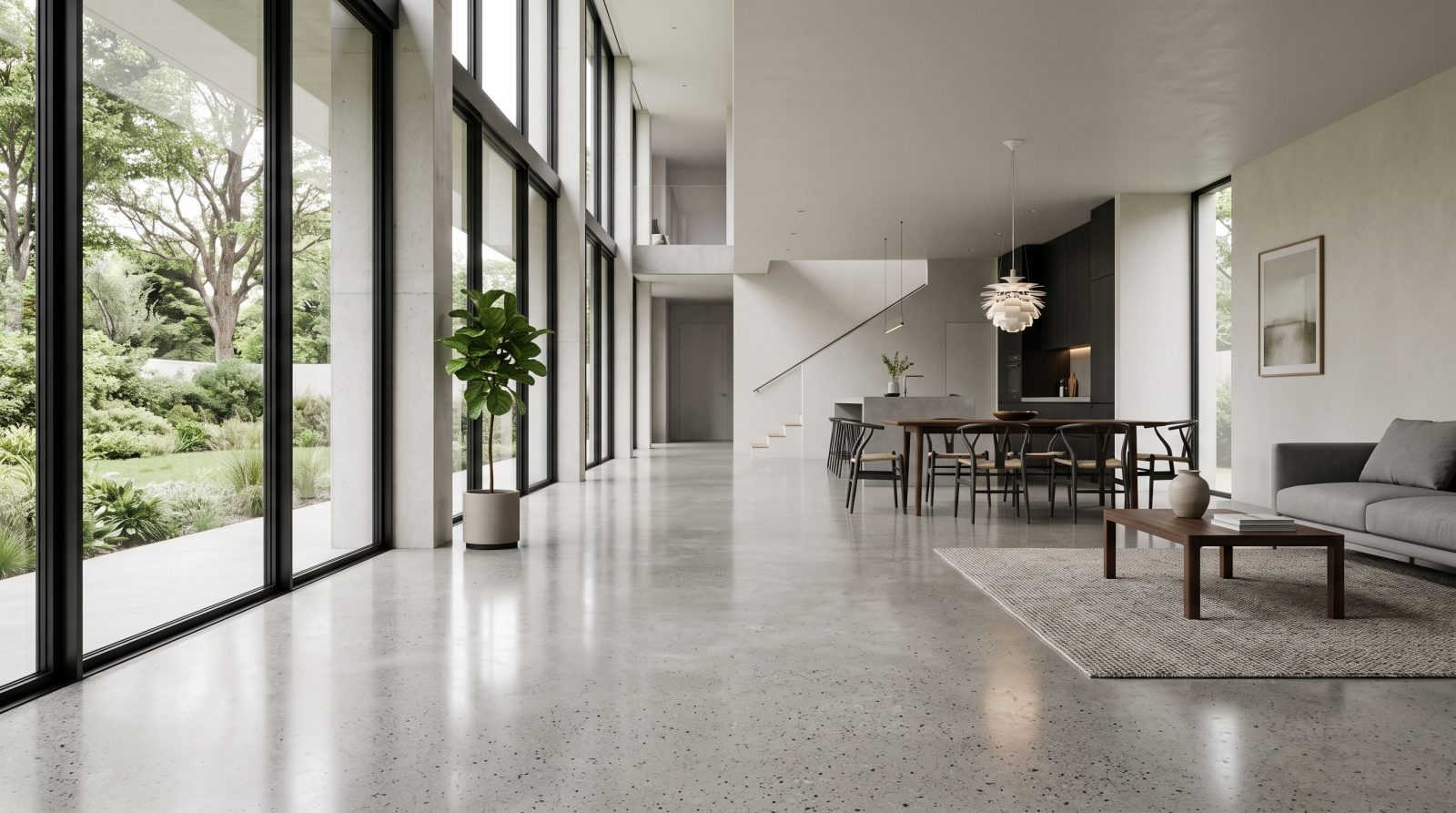
What exactly is polished concrete?
Polished concrete is not a coating, a stain, or a wax. It's a refining process: we run a planetary grinder fitted with diamond-impregnated tooling across the slab in a series of passes, each using a finer grit than the last, the same idea as sanding wood from coarse to fine. Early passes (often in the 30 to 100 grit range) remove surface imperfections, old adhesives, and flatten the floor; later passes (commonly stepping up through 200, 400, 800, and beyond) progressively close the surface until it reflects light.
Between the grinding stages we apply a chemical hardener called a densifier. This is a liquid (typically a lithium, sodium, or potassium silicate) that soaks into the concrete and reacts with it to fill microscopic pores and harden the surface from within. That internal reaction is what makes a true polished floor abrasion-resistant rather than just shiny on top.
The final sheen is a choice, not an accident. Stopping at a lower grit gives a matte or satin look; continuing to higher grits produces a semi-gloss or high-gloss finish. We can also choose how much aggregate (the stone in the concrete) shows: a light grind keeps a smooth 'cream' or salt-and-pepper look, while a deeper grind exposes more of the stone for a terrazzo-like appearance.
Polished concrete vs. epoxy and other coatings
The clearest way to understand polished concrete is to compare it to a coating. With epoxy or polyaspartic systems, we add a new material on top of the slab. With polishing, we refine the slab you already have and leave it exposed. Both are excellent floors; the right one depends on the space and the slab.
Polished concrete shines when the existing slab is sound and you want a surface that won't peel or delaminate, since there's no separate film to fail. It's naturally breathable, which matters on slabs that carry some moisture, and it tends to be very low-maintenance over its life. It is, however, only as good as the concrete underneath. Cracks, patches, and color variation in the slab stay visible to some degree, because you're looking at the real concrete.
A coating, by contrast, can hide a tired slab, add a specific color or chip-flake look, and provide a continuous chemical-resistant barrier, which is why coatings are popular in garages and workshops. The trade-off is that a coating is a film that can chip, scratch, or eventually lift if the prep or the slab conditions aren't right.
A common honest recommendation: polishing for slabs in good shape where you like the look of real concrete, and a coating where you need to mask damage, want color and pattern, or need maximum resistance to specific chemicals. We can assess your slab and tell you plainly which path fits.
How we polish a concrete floor, step by step
Every floor starts with an honest assessment. We check the slab's hardness, flatness, moisture, and surface contaminants, because those factors drive everything from the tooling we choose to how the floor will ultimately look. No two slabs polish identically, and we'd rather set accurate expectations up front than promise a finish your slab can't deliver.
- Assessment and prep: clear the space, then grind off coatings, adhesives, paint, or curing compounds so we're working on bare concrete.
- Crack and joint repair: fill cracks and control joints with a semi-rigid filler so the floor reads as one continuous surface and edges hold up to traffic.
- Coarse grinding: the first metal-bonded diamond passes flatten the slab and set how much aggregate will show.
- Densifying: apply the silicate hardener and let it react to strengthen and seal the pores from the inside.
- Honing and polishing: step up through progressively finer resin-bond diamonds to reach your chosen sheen.
- Optional protection: apply a penetrating stain guard so spills are easier to wipe before they soak in.
- Final clean and walkthrough: dust-free burnish, then we walk the floor with you so you can see the finish in your own light.
How long does it take, and when can you use the floor?
Timelines depend on square footage, the slab's condition, and how many grinding steps your chosen finish requires, but most residential and small-commercial polishing projects run roughly two to four working days. A simple, sound slab with a matte finish is on the faster end; a larger floor needing crack repair, heavy coating removal, or a high-gloss finish takes longer.
One real advantage of polishing is the cure-and-return-to-service picture. Because the densifier and most modern guards penetrate rather than form a thick film, you can typically walk on the floor within hours of the final step and return to normal use within about 24 hours, with full performance once everything has fully reacted. That's generally faster to live with than coating systems that need longer film cure times before heavy use or vehicle traffic.
We'll give you a specific schedule after seeing the slab, including realistic dust-control and access plans so you know what to expect day by day.
What polished concrete typically costs
Pricing for polished concrete is driven less by the room and more by the slab. As a general industry range, mechanically polished concrete commonly falls somewhere around $5 to $15 per square foot, with simpler basic polishing toward the lower end and more involved work, deeper aggregate exposure, decorative dyes, multiple densifier and guard steps, or extensive repair, toward the higher end. These are typical industry estimate ranges, not a quote.
The biggest cost variables are the starting condition of your slab and the finish you want. A clean, level, undamaged slab that just needs grinding and polishing costs less than one that needs old coatings or mastic removed, cracks repaired, or low spots addressed. Higher-gloss finishes and exposed-aggregate looks require more passes with finer tooling, which adds labor.
The fair way to price your floor is to look at it. We measure the space, assess slab hardness, flatness, moisture, and contaminants, and then give you a written estimate for the finish you actually want. Call us to set that up and we'll walk you through the options before any work begins.
Is polished concrete a good fit for South Bay homes and shops?
For much of the South Bay, polished concrete is a sensible, practical choice. The region's mild, relatively dry coastal climate is gentle on slabs, which helps a polished floor look good for the long haul, though spaces nearer the bay can carry more ambient moisture, which is exactly why we test the slab before committing to a finish.
A lot of South Bay housing stock, from mid-century homes to newer infill builds, sits on concrete slab-on-grade foundations, and many garages, ADUs, and converted shop spaces already have a usable slab underneath the existing flooring. In those cases, polishing turns concrete you already paid for into the finished floor, which is often more cost-effective than tearing out and replacing.
It's also a strong fit for the area's many home workshops, maker spaces, and small commercial showrooms, where owners want a clean, bright, durable floor that handles tools, foot traffic, and the occasional vehicle without the upkeep of tile grout or the wear patterns of vinyl. The honest caveat remains the same everywhere: an older or previously damaged South Bay slab will show its history, so we assess first and tell you whether polishing or a coating will serve you better.
Caring for a polished concrete floor
One of the best things about polished concrete is how little it asks of you. For day-to-day care, dust mop or vacuum to keep grit off the surface, since loose grit is the main thing that dulls a floor over time, and damp mop with a pH-neutral cleaner. Avoid harsh acidic or highly alkaline cleaners, which can etch or degrade the polished surface and the densifier's work.
Wipe spills reasonably promptly. Polished concrete is far more stain-resistant than bare concrete, especially with a penetrating guard, but it isn't bulletproof, and acidic liquids like wine, citrus, or certain chemicals can mark an unprotected area if left to sit. The good news is that maintenance is simple: a periodic re-burnish and, depending on traffic, occasional reapplication of the stain guard will keep the sheen looking fresh for years.
Because the finish is part of the slab rather than a film on top, you generally won't deal with peeling or flaking, and minor scuffs can often be buffed rather than recoated. We'll leave you with clear, specific care instructions for the exact finish we install.