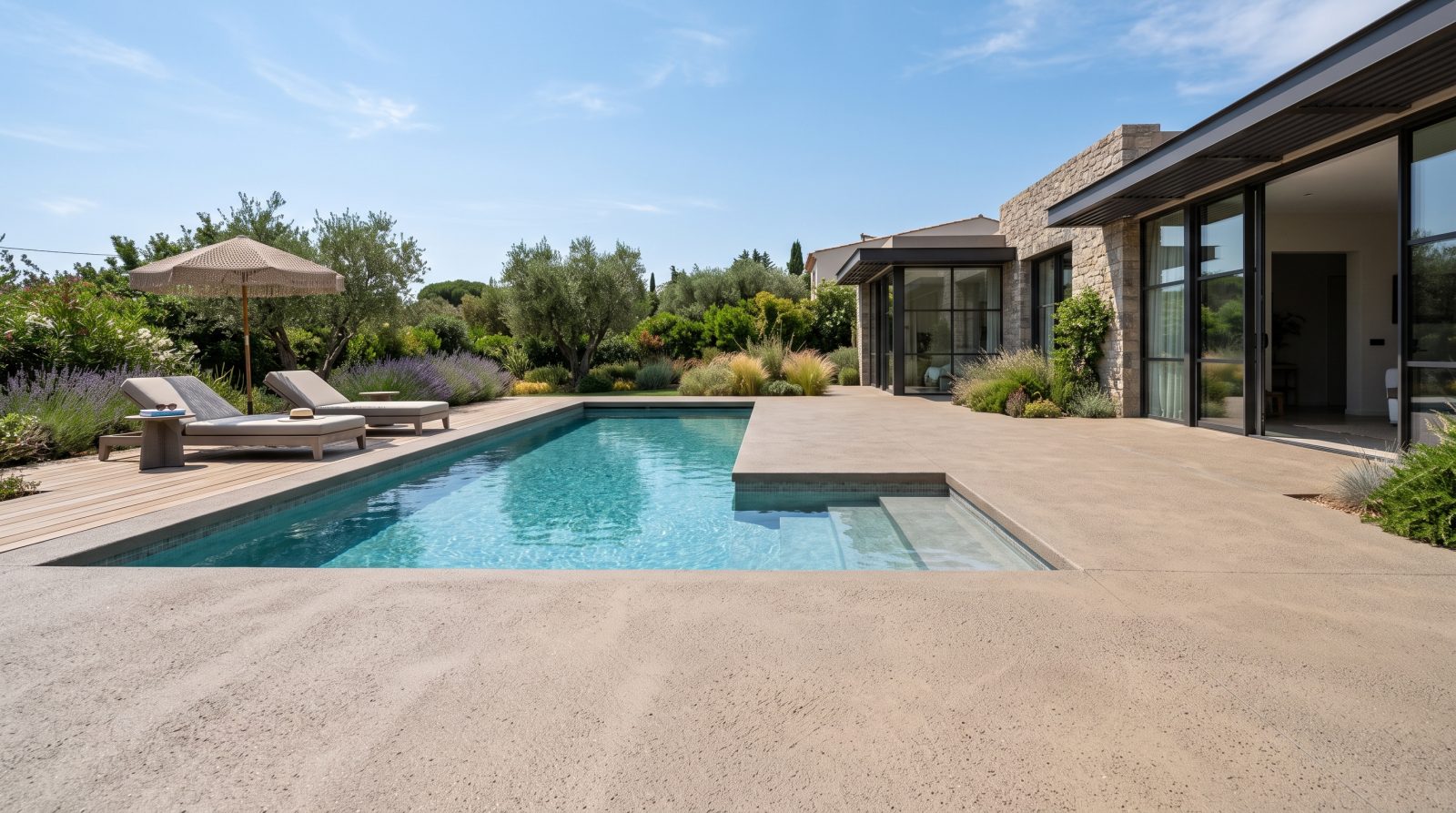
Why pool decks and patios need a different coating than a garage
Indoor garage epoxy and outdoor pool-deck coatings solve different problems. A garage floor lives in shade, stays dry most of the year, and mainly fights hot tires and oil. A pool deck sits in full sun, gets soaked daily, takes chlorine and salt-system splash-out, and bakes to surface temperatures well above ambient on a hot South Bay afternoon. Put a standard solid epoxy outdoors and it will typically yellow (amber) and chalk within a season or two because the resin is not UV-stable.
The systems built for outdoor concrete are different by design. UV-stable polyaspartic topcoats, acrylic cement overlays, and textured 'cool deck' resurfacers are formulated to hold color in sunlight, flex slightly with temperature swings instead of cracking, and shed water fast. They are also built around traction: a smooth coating that looks great dry can be dangerous around a pool, so outdoor finishes use broadcast aggregate, knockdown texture, or a non-slip additive in the topcoat.
Heat matters too. Bare gray concrete and especially dark surfaces absorb heat and can be uncomfortable to stand on barefoot. Lighter-colored, textured deck coatings reflect more sunlight and stay noticeably cooler than dark or bare concrete, which is one of the most-requested benefits for families with kids and pets.
What's included in a pool-deck and patio coating project
Most of the durability of an outdoor coating is decided before any color goes down. The bond between the coating and your concrete is everything, so prep is the bulk of the real work.
Here is what a complete, done-right outdoor coating project generally involves:
- Inspection and moisture check: we look for active cracks, spalling, hollow or delaminating spots, drainage issues, and how much moisture is moving up through the slab.
- Surface prep: mechanical profiling by grinding or shot-blasting (not just acid-washing) so the coating can mechanically key into the concrete.
- Crack and joint repair: routing and filling cracks, patching spalled edges, and respecting expansion/control joints so the slab can still move.
- Cleaning and decontamination: removing oils, sunscreen residue, chlorine deposits, and old sealers that would otherwise block adhesion.
- Base and color coat: applying the resurfacer or basecoat, then the chosen color, texture, or decorative finish.
- Non-slip topcoat: a UV-stable sealer with traction additive so the deck stays grippy when wet.
- Cure and walkthrough: protecting the area during cure, then a final walkthrough on care and re-entry timing.
Coating options for outdoor concrete
There is no single 'best' outdoor coating — the right choice depends on the condition of your concrete, the look you want, and how the space is used. These are the systems most commonly used on South Bay patios and pool decks:
- Acrylic-cement 'cool deck' resurfacing: a textured, sprayed-on overlay that hides minor surface wear, stays cooler underfoot, and offers strong slip resistance — a widely used option for pool decks.
- Polyaspartic / polyurea systems: fast-curing, UV-stable, and abrasion-resistant; often paired with a decorative flake or quartz broadcast and a non-slip topcoat. Many polyaspartic systems can return to light use within about 24 hours.
- Stamped or stenciled overlays: thin cementitious overlays textured to mimic stone, brick, or tile for a more custom patio look.
- Stains and decorative sealers: for concrete in good shape that mainly needs color and UV protection rather than a full resurface.
How long it takes and how long it lasts
For a typical residential patio or pool deck, the on-site work usually runs one to three days, driven mostly by prep and the number of coats. After the final coat, plan on roughly 12 to 24 hours before light foot traffic, and about 2 to 5 days before returning furniture, swimming, and full use. Cure times are not fixed numbers — they stretch in cool or humid weather and shorten in warm, dry conditions, which is why coastal South Bay mornings and marine-layer humidity get factored into scheduling.
Outdoor coatings perform best when installed in moderate, dry weather. Resin systems generally want the slab and air temperature in a workable range (commonly around 50 to 90°F) with low risk of rain or sprinkler overspray during cure, and they need the concrete itself to be dry — not just the surface, but moisture moving up from below the slab. A moisture check up front prevents the most common cause of premature peeling.
Lifespan depends on the system, sun exposure, and maintenance, but a properly prepped and topcoated outdoor system can give many years of service before it needs a fresh topcoat to refresh color and traction. Re-coating the topcoat periodically is normal and far cheaper than a full redo — it's how these surfaces are meant to be maintained over time.
South Bay conditions we plan around
The South Bay climate is gentle on concrete in some ways and tough in others, and good outdoor coating work accounts for both. Long, dry, sunny summers mean UV exposure is the number-one enemy of outdoor finishes here — it's the reason we steer clients away from standard indoor epoxy outdoors and toward UV-stable systems that hold their color.
Moisture shows up in less obvious ways. Marine-layer mornings and irrigation overspray can keep a slab damp longer than homeowners expect, and older patios near mature landscaping often have drainage or root-heave issues that need to be addressed before coating. We also see a lot of decades-old concrete around established neighborhoods — slabs that have already cracked or spalled and benefit from a resurfacing overlay rather than a thin sealer.
Pool chemistry is the other local factor. Salt-system and chlorine pools both leave residue around the deck edge that has to be cleaned off before coating, and a chemical-resistant topcoat protects the finish from ongoing splash-out. Where these conditions are real for your specific property, we'll point them out during the on-site visit rather than guessing.
What a coating costs (typical ranges, not a quote)
Outdoor coating pricing is usually figured by the square foot and varies widely with the condition of your concrete, the system you choose, and how much crack repair and prep is needed. As a general industry guide — not a quote for your project — simpler resurfacing and sealing work tends to fall toward the lower end per square foot, while decorative overlays, multi-coat polyaspartic systems, and heavy repair work fall higher.
The biggest single cost driver is the condition of the existing slab. A deck that's structurally sound and just needs cleaning, color, and a topcoat costs far less than one that needs extensive crack routing, spall patching, or leveling first. Square footage, the number of colors or decorative effects, and access to the work area also move the number.
Because every slab is different, the only honest way to price your job is to see it. We provide a free on-site estimate in writing, so you can see exactly what's included before any work starts. Call us to set up a visit.
Ready to upgrade your patio or pool deck?
If your concrete is fading, cracking, getting too hot underfoot, or just looking tired, a coating can transform it for a fraction of the cost of tearing it out and repouring. The first step is simple: we come look at the actual surface, talk through the right system for your conditions, and give you a written estimate with no pressure.
Reach out by phone to schedule your free on-site assessment. We'll walk your patio or pool deck, check the slab, and lay out clear options and realistic timing.