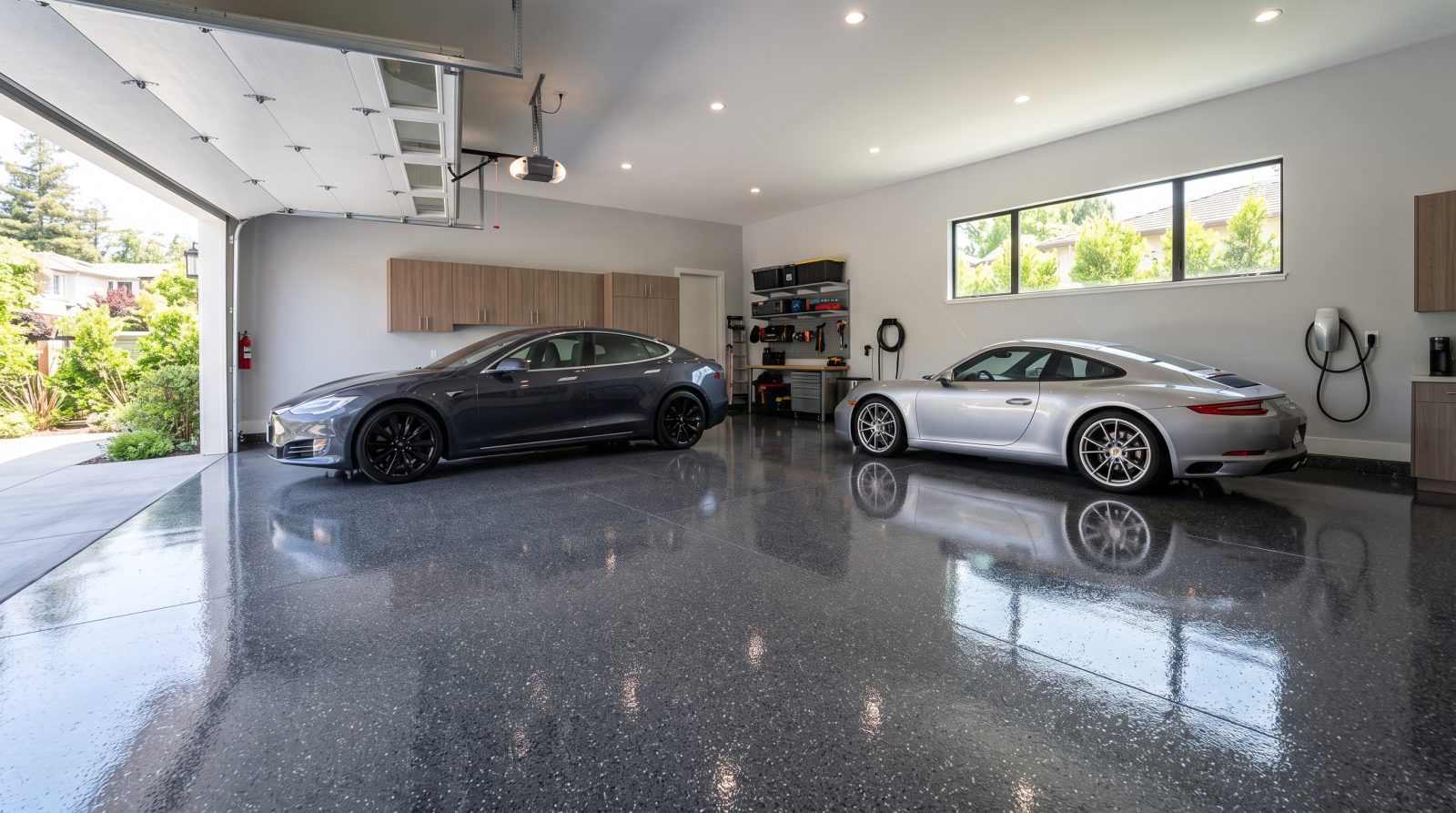
Why Milpitas concrete floors need the right coating
Milpitas has a mild Mediterranean climate: warm, dry summers and cool, wet winters where most of the year's rain falls between November and March. That seasonal swing is the backdrop for two real problems on local concrete. First, the wet season drives moisture up through slabs, especially in older neighborhoods built on the flatter, lower ground toward Coyote Creek and the bayfront salt ponds, where the water table sits higher. Second, summer heat in an attached garage can soften a low-quality coating and cause 'hot-tire pickup,' where a coating lifts off when warm tires park on it.
A lot of Milpitas housing stock is slab-on-grade construction, including the 1960s and 70s tract homes around the older central neighborhoods and the newer developments near the Great Mall and the Montague Expressway corridor. Slab-on-grade means your garage and ground-floor concrete sit directly on the soil, so whatever moisture is in that soil can reach the underside of the slab. A coating that ignores this can bubble, peel, or cloud within a season. A coating system matched to the slab condition, applied after a moisture test and proper prep, is what holds up.
The fix is not just a thicker coating, it is the right system on a correctly prepared surface. For most Milpitas garages that means mechanically profiling the concrete, repairing cracks and pitting, confirming the slab is dry enough to bond, and then applying a coating built for the conditions. Done that way, the floor shrugs off oil drips, road salt tracked in from winter trips over the Sunol Grade, and the constant in-and-out of a busy household garage.
What coating is right for your Milpitas garage or slab?
The right coating depends on how the slab is used, how much moisture it sees, and how fast you need it back in service. Here are the systems we most often recommend for Milpitas homes and businesses, with the honest trade-offs of each.
Epoxy is the workhorse for residential garages. A typical professional epoxy system is built up to roughly 8 to 20 mils thick (a mil is one-thousandth of an inch) and bonds hard to properly profiled concrete. It handles oil, brake fluid, and daily abuse well and takes decorative flakes or a solid color. Its main limits are a slower cure and a sensitivity to UV, so for sun-exposed patios or driveways it is usually paired with a UV-stable topcoat.
Polyaspartic and polyurea coatings cure much faster and resist UV yellowing, which makes them well suited to sunny South Bay patios, pool decks, and any job where you need the space back quickly. They can often be walked on the same day and driven on within a day or two, versus several days for a full epoxy build. They cost more per square foot than basic epoxy. A common high-performance approach is a hybrid: an epoxy base coat for adhesion and build, finished with a polyaspartic topcoat for speed and UV durability.
For slabs with elevated moisture, which is a real consideration on the lower-lying parts of Milpitas, a moisture-mitigating primer or vapor-barrier coating may be needed before the main system. This is exactly why a moisture test up front matters. Skipping it to save a step is the most common reason a garage floor coating fails early.
How the coating process works, step by step
A durable floor is roughly 80 percent preparation and 20 percent coating. Here is the sequence we follow so you know what to expect and can compare it against any other quote.
Every project starts with assessment and a moisture test, then thorough surface prep, repairs, coating application, and a controlled cure. The details below are the kind of specifics an experienced installer should be able to confirm for your slab.
- Assess and moisture-test: inspect for cracks, spalling, prior sealers, and oil saturation, then test the slab for moisture so the right system is chosen before anything is applied.
- Profile the concrete: mechanically grind (or in some cases shot-blast) the surface to open the pores so the coating can bond. Acid etching alone is generally not enough for a long-lasting professional result.
- Repair: fill cracks, fill pits and spalls, and degrease oil-stained areas; many garages near busy work-truck households need extra degreasing.
- Apply the system: prime if needed, lay the base coat, broadcast decorative flake if chosen, then seal with the topcoat at the specified mil thickness.
- Cure and return to service: respect cure times before foot and vehicle traffic. Cure depends on the chemistry and on temperature and humidity, so cool, damp Milpitas winter days can extend the wait while warm summer days shorten it. Always follow the installer's product-specific cure schedule rather than a generic number.
Typical cost ranges for floor coating in Milpitas
The costs below are typical industry ranges to help you budget; they are estimates, not a quote. Your actual price depends on slab size, condition, the coating system, how much repair and degreasing the concrete needs, and current material prices. The only way to get a real number is an on-site look at your specific floor.
As a rough planning guide for the South Bay: a basic single-color professional epoxy garage floor often falls in a lower per-square-foot band, a flake epoxy system with a clear topcoat sits in a mid band, and a full polyaspartic or epoxy-polyaspartic hybrid system is typically the highest band because of faster cure, UV stability, and material cost. A standard two-car Milpitas garage is commonly in the 400 to 600 square foot range, which is the figure most homeowners use to scale these estimates.
Two things move the price most in Milpitas specifically. First, moisture mitigation: if a test shows elevated slab moisture, the added vapor-barrier step raises cost but prevents a failure that would cost far more to redo. Second, repair scope: older slabs with significant cracking, spalling, or deep oil staining take more prep time. A transparent estimate should itemize prep, repairs, the coating system, and cure time so you can see exactly what you are paying for.
Serving Milpitas and the surrounding South Bay
We coat floors for homes and businesses throughout Milpitas, from the neighborhoods near the Great Mall and McCarthy Ranch to the older central areas off Calaveras Boulevard and the hillside homes up toward Ed Levin County Park. Residential garages and patios are the most common projects, but the same systems serve light-commercial and industrial slabs in Milpitas's business and warehouse districts along the Montague and I-880 corridors.
Beyond the garage, common local uses include patio and entertaining areas that take advantage of the long dry South Bay summer, basement and utility-room floors, workshop and hobby spaces, and small commercial floors like shops and service bays. If you are in a nearby community in Santa Clara County and want the same approach, ask us about your address; the climate and soil considerations described here apply broadly across the South Bay.
To get started, request an on-site assessment so we can moisture-test the slab and recommend the right system for how you actually use the space. You may call the number listed on this site to schedule. We will give you an honest read on your concrete's condition and a clear, itemized estimate before any work begins.