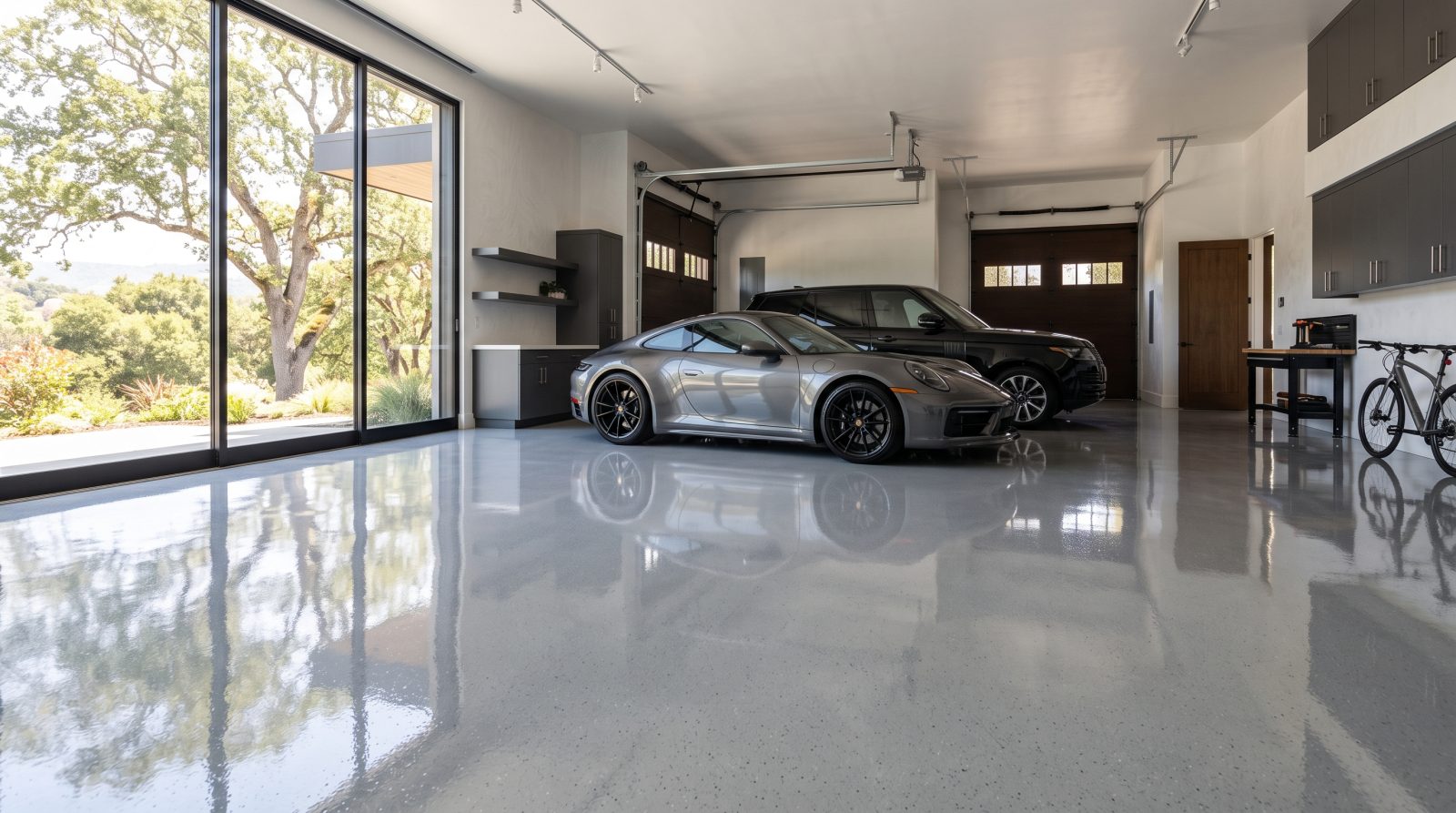
Why Morgan Hill concrete needs the right prep
Morgan Hill sits in the South Santa Clara Valley, and much of the area is built on expansive clay that swells when the winter rains arrive and shrinks as it dries through the long, hot summer. That seasonal movement is the single biggest reason garage and shop slabs here develop hairline cracks, settlement lines, and the occasional lifted joint. A coating cannot stop a slab from moving, but the prep work decides whether the finish bridges small movement gracefully or peels and chips the first time the ground shifts.
The local climate adds a second challenge. Summer afternoons routinely climb into the 90s while nights cool off sharply, so an uninsulated garage slab can swing through a wide temperature range in a single day. Coatings are sensitive to both slab temperature and surface humidity at the time of install, which is why a careful installer schedules around those swings and checks conditions before mixing anything.
The honest takeaway: in Morgan Hill the product matters less than the preparation. Mechanical grinding to open the concrete pores, a moisture test of the slab, and proper crack and joint treatment are what separate a coating that lasts from one that fails early.
- Expansive clay soils move seasonally and can transmit stress into the slab
- Hot-dry summers and cool nights create wide daily slab temperature swings
- Older ranch-era slabs and newer subdivision pours each call for different prep
- Moisture testing matters because vapor rising through a slab is a leading cause of coating failure
What we coat in Morgan Hill homes and shops
Morgan Hill's housing is a mix: established homes near the downtown Monterey Road corridor with single- and two-car attached garages, plus newer subdivisions on the east and west sides with larger two- and three-car garages. We coat all of them, and the approach is matched to the slab's age and condition rather than a single one-size finish.
Beyond the garage, the valley's agricultural and winery heritage means many properties have shop floors, barns, equipment sheds, and outbuilding slabs that take real abuse. Concrete coatings hold up well to dropped tools, vehicle traffic, and chemical spills when the system is matched to the use. Covered patios and entryways are also good candidates where a homeowner wants a cleaner, sealed surface that shrugs off summer dust.
Common local projects include residential garage floors, hobby and woodworking shops, agricultural and equipment buildings, covered patios, bonus rooms in newer builds, and small-business or light-warehouse floors near the rail corridor.
- Attached residential garages, from older single-car to newer three-car bays
- Workshops, hobby spaces, and home gyms
- Barns, equipment sheds, and outbuilding slabs common on valley properties
- Covered patios, entryways, and sunrooms
- Light-commercial and small warehouse floors
Epoxy, polyaspartic, or polished concrete: which fits a Morgan Hill garage?
There is no single best system; the right choice depends on how the floor is used and how quickly you need it back in service. Epoxy is a thick, durable base layer that fills minor imperfections and bonds well to properly ground concrete. Polyaspartic (a polyurea-based topcoat) cures fast, resists UV yellowing, and handles temperature swings well, which makes it a strong fit for Morgan Hill garages that catch direct sun or wide daily temperature changes. Many quality installs pair an epoxy base with a polyaspartic topcoat to get the strengths of both.
Cure time is a practical planning factor. As a general guide, a standard epoxy coat typically needs roughly 24 hours before light foot traffic and about 72 hours before you park a vehicle on it, with full chemical cure taking up to a week. A polyaspartic system can often be walked on within hours and ready for vehicles in about 24 hours, which is why it is popular when downtime needs to be short. Actual times depend on slab temperature and humidity at install.
Decorative flake (broadcast vinyl chips) and quartz systems add slip resistance and hide minor surface variation, while polished or stained concrete keeps a more natural look without a film coating. We will walk you through the trade-offs for your specific slab rather than pushing one product.
- Epoxy: thick, durable base layer; commonly about 72 hours before vehicle traffic
- Polyaspartic: fast-curing, UV-stable topcoat; often vehicle-ready in about 24 hours
- Epoxy base plus polyaspartic topcoat: a common durable combination
- Flake and quartz broadcasts add slip resistance and hide imperfections
- Residential coatings typically run roughly 8 to 20+ mils thick depending on the system
Our local process, from estimate to cured floor
Every Morgan Hill project starts with a free on-site assessment. We look at the slab's age, existing cracks, any prior coatings or sealers, and signs of moisture, then talk through how you use the space. Any cost figures we mention beforehand are clearly labeled estimates based on typical industry ranges, not fixed quotes, until we have seen your floor in person.
The install follows a consistent sequence: diamond-grind the surface to create a mechanical profile, repair cracks and joints, test for moisture so we do not trap vapor under the coating, then apply the base, broadcast any decorative flake, and seal with the topcoat. We schedule around the area's daily temperature swings so the slab and air conditions stay within the manufacturer's window during application and cure.
Surface prep is the step most low-bid jobs cut. Acid etching alone is not equivalent to mechanical grinding, and skipping moisture testing is a common cause of coatings that bubble or delaminate months later. We do the prep properly because it is the only honest way to make a coating last on Morgan Hill's moving slabs.
- Free on-site assessment and a clearly labeled estimate range
- Diamond grinding for a true mechanical bond, not just an acid etch
- Moisture testing before any product is applied
- Crack and joint repair tuned to expansive-soil movement
- Scheduling around local temperature and humidity for a clean cure