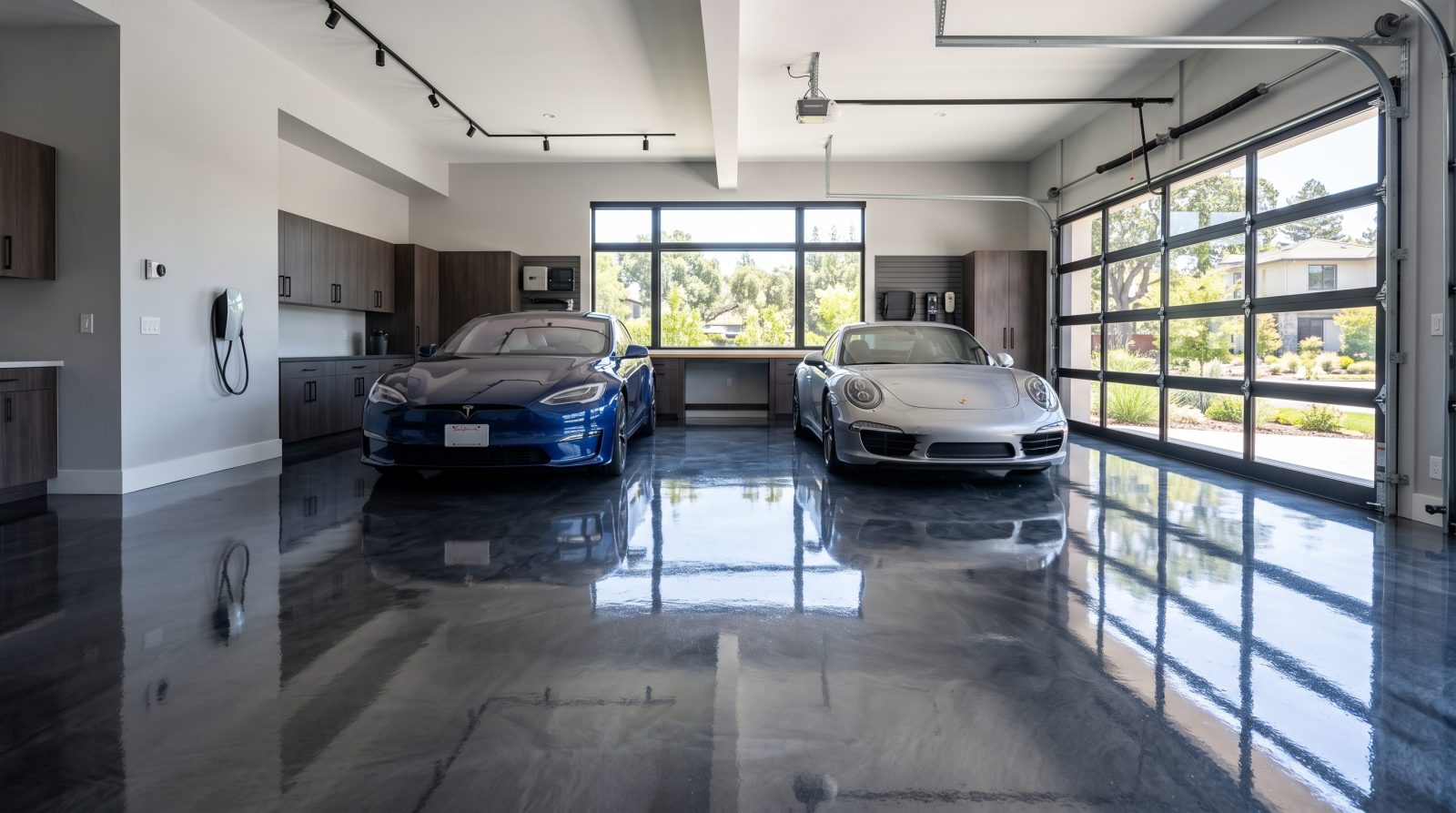
Why Fremont concrete needs a coating built for the conditions
Fremont sits at the southeast edge of San Francisco Bay, and the ground here tells the story: large stretches of the city are built on bay mud, alluvial soil, and former marshland flats, especially in the Ardenwood, Centerville, and Niles-area lowlands closer to the water. That matters for floor coatings because slabs poured over moist, expansive soils can push water vapor up through the concrete. When vapor pressure is high and a coating is applied without checking for it, even a good epoxy can bubble, blister, or peel months later. A coating chosen for Fremont should start with a moisture check, not just a color sample.
Fremont's climate is mild but not coating-friendly by default. The Mediterranean pattern brings a wet winter and a dry summer, and the marine influence off the bay keeps humidity and morning dampness higher than inland valleys. Resin coatings are sensitive to temperature and humidity while they cure, so the same product can behave very differently on a damp February morning in the flats versus a warm, dry afternoon in the Mission San Jose hills. A contractor who works in Fremont plans the install window and the product around that reality rather than treating every garage the same.
Fremont garages also see real use. Many households here run multiple vehicles, EVs that get plugged in nightly, weekend hobby work, and storage for everything from bikes to gym equipment. A coating that only looks good is the wrong goal; the floor needs to take hot tires, dropped tools, and the occasional oil or coolant drip without staining or wearing through.
What kind of floors do Fremont homes and shops usually have?
Fremont's housing stock is varied, and the floor type often tells you which coating system makes sense. The city grew quickly from the 1950s onward as it merged five older districts, so there are mid-century slabs in neighborhoods like Centerville and Irvington, large tract-home developments from the 1960s through the 1980s across Ardenwood and Warm Springs, and newer construction in the Warm Springs and Innovation District areas near the BART station. Older slabs are more likely to have surface cracks, prior paint, or oil saturation that has to be addressed during prep; newer slabs are often cleaner but can still be 'green' or sealed in ways that affect adhesion.
Most residential projects here are two- and three-car attached garages, which suit a full broadcast-flake epoxy or a polyaspartic system well. Patios, walkways, and the occasional pool deck are common too, and those benefit from UV-stable, slip-resistant finishes because they sit in direct sun and get wet. On the commercial side, Fremont's industrial corridors in Warm Springs and along the I-880 frontage hold auto shops, light manufacturing, and warehouse space where high-build epoxy or polyaspartic floors handle forklift traffic and chemical exposure.
- Attached 2-3 car garage slabs (most common residential project)
- Older mid-century slabs that may need crack repair and degreasing
- Patios, walkways, and pool decks needing UV-stable, slip-resistant finishes
- Commercial and light-industrial floors in the Warm Springs / I-880 corridor
How the install works on a Fremont slab
A lasting coating is roughly 80 percent preparation and 20 percent product. The process starts with a moisture and condition assessment of the slab, because Fremont's bay-influenced ground makes vapor a real variable. From there the concrete is mechanically profiled, usually by diamond grinding or shot blasting, so the resin can bond into the surface rather than sitting on top of it. Cracks, pits, and spalled areas are repaired, oil-saturated spots are degreased and treated, and the floor is vacuumed clean before any coating goes down.
For a flake (chip) system, a base coat is applied, decorative vinyl flakes are broadcast into it, and once cured the excess is scraped and the floor receives one or more clear topcoats. Polyaspartic systems follow a similar sequence but cure much faster, which is useful in Fremont's cooler, damper months when slow-curing epoxy can struggle. Concrete itself needs to cure about 28 days before it is ready to be coated, so new construction and recent slab repairs should be planned around that window.
Cure and return-to-service times depend on the product and the weather on install day. As a general guide, many systems are ready for foot traffic within a day and vehicle traffic in a few days, with polyaspartic often faster than traditional epoxy. Because temperature and humidity directly affect curing, the right install window in Fremont is usually a dry, mild stretch rather than a damp morning.
- Moisture and slab-condition check before anything else
- Mechanical prep (diamond grinding or shot blasting), not acid-etch alone for a long-term floor
- Crack, pit, and oil-stain repair, then a thorough clean
- Base coat, flake broadcast (if chosen), and clear protective topcoat(s)
- New or repaired concrete typically needs ~28 days to cure before coating
Epoxy vs. polyaspartic: which fits a Fremont garage?
Both epoxy and polyaspartic are resin coatings, and both can produce a beautiful, durable floor; the right pick depends on your slab, your schedule, and how the space is used. Traditional epoxy builds a thick, hard film and is cost-effective, but standard epoxy can amber (yellow) under direct UV and cures more slowly, which is a factor during Fremont's cooler, wetter months. Polyaspartic (a polyurea-family coating) is more UV-stable, cures fast even in lower temperatures, and stays flexible, which helps on slabs that move slightly with seasonal moisture, common on Fremont's softer soils.
A common and reliable approach here is a hybrid: an epoxy base coat for build and adhesion, decorative flakes for grip and looks, and a polyaspartic clear topcoat for UV resistance and a faster return to service. This balances cost against durability and is a strong default for a Fremont two- or three-car garage. For patios and pool decks that bake in summer sun, a UV-stable topcoat is important so the finish does not yellow or chalk over time.
Coating thickness is measured in mils (thousandths of an inch). A thin one-day 'garage paint' job is different from a multi-coat system; ask any contractor what total mil thickness and how many coats their quote includes, because that is what separates a floor that lasts a year from one that lasts many.
- Epoxy: thick film, budget-friendly, slower cure, standard versions can yellow in UV
- Polyaspartic: fast-curing even when cool, UV-stable, more flexible, costs more
- Hybrid (epoxy base + flake + polyaspartic topcoat): popular all-rounder for Fremont garages
- Ask for total mil thickness and number of coats, not just a color
What does a coated floor cost in Fremont?
Pricing depends on the size and condition of your slab, the system you choose, and how much prep and repair the concrete needs, so the figures below are typical industry estimate ranges, not quotes. As a rough guide, professional resin floor coatings often fall somewhere in the range of about $4 to $12 per square foot for a full broadcast-flake or polyaspartic system, with higher-end metallic or heavy-duty industrial finishes costing more. A standard two-car garage of roughly 400 to 500 square feet therefore commonly lands in the low-to-mid four figures, depending on the variables above.
Condition is the biggest swing factor on a Fremont slab. A clean, sound newer floor in Warm Springs needs less prep than a 1960s garage in Centerville with oil staining, cracks, and old peeling paint. Moisture mitigation, if testing shows it is needed, adds cost but protects the entire investment; it is far cheaper to install a vapor barrier or moisture-tolerant primer up front than to redo a floor that blistered. The cheapest option is rarely the lowest cost over time.
When you compare estimates, make sure you are comparing the same scope: the prep method (grinding or shot blasting versus a quick etch), the number of coats and total mil thickness, the topcoat type, and the warranty. A genuine quote comes after someone has seen your slab. To get an estimate tailored to your floor, reach out and we will walk you through the options for your space.
- Typical industry estimate: roughly $4-$12 per sq ft for a full flake or polyaspartic system (estimate, not a quote)
- Two-car garage (~400-500 sq ft) commonly lands in the low-to-mid four figures
- Slab condition and required prep drive most of the price difference
- Moisture mitigation, if needed, adds cost but prevents far more expensive failures
- Always compare prep method, coats, mil thickness, topcoat, and warranty