Why Palo Alto slabs need careful moisture prep
Palo Alto sits on the flat valley floor of the mid-Peninsula, where many neighborhoods were built on slab-on-grade foundations from the 1950s and 60s. Those older slabs were often poured with little or no vapor barrier underneath by today's standards, which means ground moisture can migrate up through the concrete and push against a coating from below. When moisture vapor exceeds what a coating can tolerate, even a well-applied epoxy can blister or peel. That is why a moisture test before coating matters more here than the brand of product on the can.
A reputable installer will check the slab with a calcium chloride test or relative-humidity probes before committing to a system. If readings are high, the answer is not to skip the coating but to choose a moisture-tolerant primer or a vapor-mitigation base coat rated for the conditions. Spending a little extra on the primer is far cheaper than redoing a failed floor a year later.
Palo Alto's marine-influenced climate adds a second wrinkle: mild temperatures but real humidity swings, especially during the spring and early-summer marine layer. Humidity affects how a coating cures, so an experienced crew watches the dew point and slab temperature, not just the air temperature, when scheduling the application window.
- Older Eichler and ranch slabs often lack a modern vapor barrier
- Calcium chloride or RH testing reveals hidden vapor drive before coating
- Moisture-tolerant primers handle slabs that would defeat a basic epoxy
- Crews track slab temperature and dew point, not just air temperature
What's the best coating for an Eichler or mid-century garage floor?
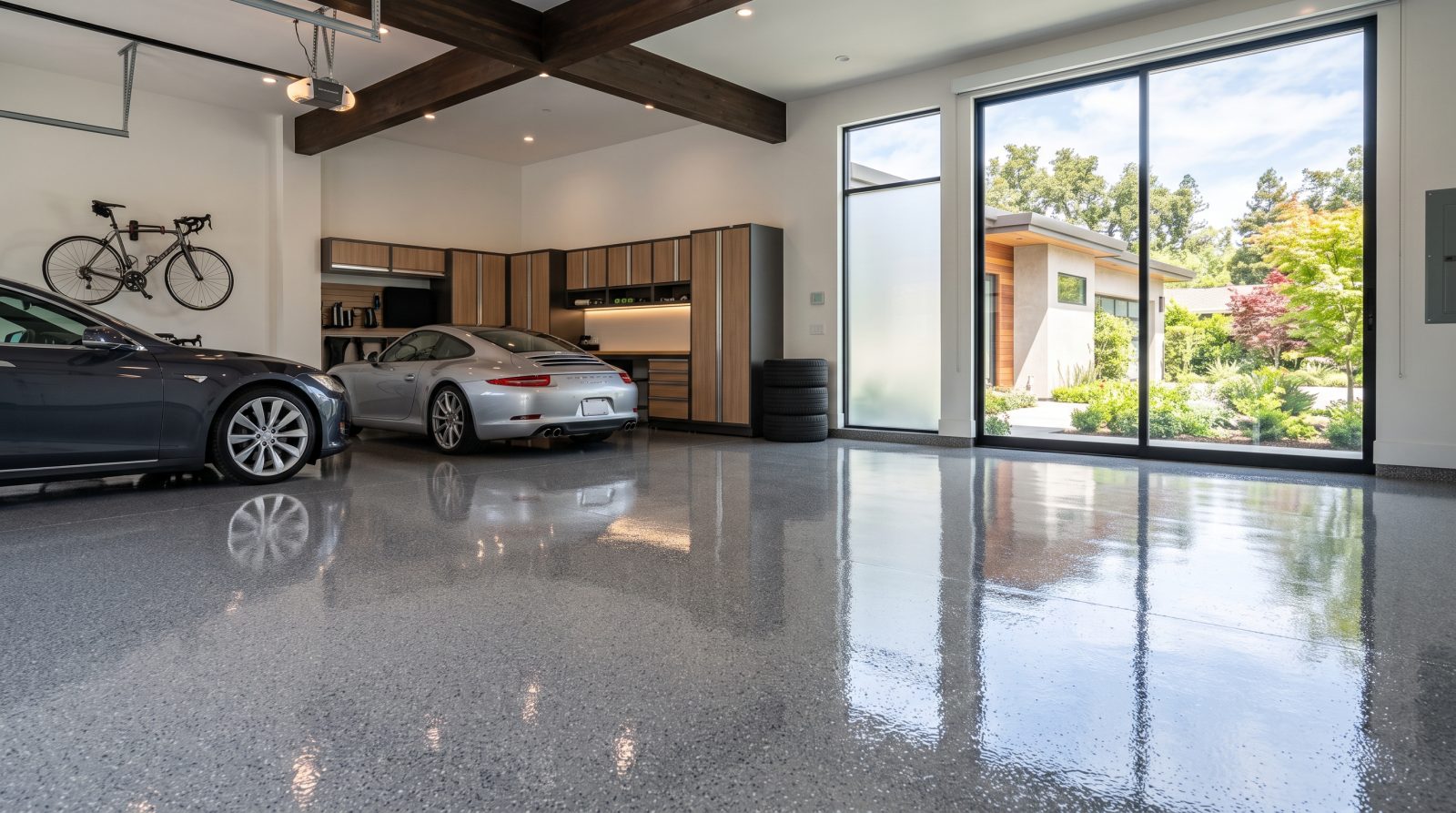
Palo Alto has one of the densest concentrations of Eichler homes in the country, especially in neighborhoods like Greenmeadow, Fairmeadow, and Greer Park. These mid-century homes typically have an attached or carport-style slab and post-and-beam construction, and their garages see daily in-and-out traffic. For that kind of use, a flake (broadcast) epoxy floor with a clear polyaspartic or polyurethane topcoat is a popular choice because the topcoat resists UV yellowing and hot tire pickup better than epoxy alone.
For homeowners who want the shortest downtime, a polyaspartic system can often be ground, coated, and walked on within a day or two, since polyaspartic cures faster than traditional epoxy. Straight epoxy is still a strong, budget-friendly option for interior garages that don't get direct sun. The right pick depends on how the space is used, how much sunlight reaches the slab, and how quickly you need the floor back in service.
Whatever the system, the decorative flake also serves a practical purpose: it hides minor slab imperfections common in older concrete and adds slip resistance, which is welcome on a garage floor that occasionally gets wet from a rained-on car.
- Flake epoxy with a polyaspartic topcoat balances looks, durability, and UV resistance
- Polyaspartic systems cut downtime to roughly a day or two
- Decorative flake adds slip resistance and hides older-slab imperfections
- Sun exposure on the slab should guide whether you choose a UV-stable topcoat
How the installation works, step by step
A quality floor coating is mostly preparation. The first step is mechanically profiling the concrete, usually by diamond grinding, to open the surface so the coating can bond. Acid etching alone is generally not enough for a long-lasting result on a garage slab, and grinding also removes old paint, sealers, and contamination. Any cracks, pitting, or spalled areas are then repaired and the slab is vacuumed dust-free.
Next comes the primer or moisture-mitigation coat chosen based on the earlier moisture test, followed by the base color coat. If flake is part of the design, it is broadcast into the wet base coat to refusal, then the excess is scraped and the floor is topped with one or two coats of clear sealer. Most residential garages are done in one to two working days depending on the system.
Cure times matter for planning. As a general rule, you can typically walk on a finished floor within about 12 to 24 hours, and return vehicles after roughly three to seven days, with polyaspartic on the faster end and epoxy on the slower end. Your installer should give you specific cure windows for the exact products used and the conditions on your job.
- Diamond grinding (not just acid etching) creates a reliable bond
- Cracks, pits, and spalls are repaired before any coating
- Flake is broadcast to refusal, then sealed with one to two clear coats
- Typical timeline: walk in ~12-24 hours, drive in ~3-7 days
Typical cost ranges in the Palo Alto area
Floor coating is usually priced by the square foot, and the final number depends mostly on slab condition and the system you choose. As a typical industry range, a basic single-color epoxy on a sound slab tends to fall in the lower per-square-foot tier, a flake epoxy with a clear topcoat in the middle, and a full polyaspartic system on the higher end. These are estimates to help you budget, not a quote.
Several Palo Alto-specific factors can move the price. Older slabs that need crack repair, spall patching, or moisture mitigation add labor and material. A two-car garage roughly 400 to 500 square feet is the most common residential job, while detached shops, patios, and carports are quoted separately. Anything that requires moving heavy items, removing failed prior coatings, or extensive grinding will also affect the total.
The most accurate way to budget is an on-site look at your actual slab. A walk-through lets an installer see the concrete's condition, test for moisture, measure the area, and confirm the system that fits your use and timeline. Call the number on this page to talk through your floor and get an estimate.
- Pricing is per square foot; slab condition and system drive the total
- Basic epoxy is the lowest tier; flake systems mid; polyaspartic highest
- Crack repair, spall patching, and moisture mitigation add cost
- A typical two-car garage is roughly 400-500 sq ft; shops and patios quoted separately
Beyond the garage: shops, patios, and ADUs
Garages are the most common project, but the same coatings work well on other Palo Alto surfaces. With the growth of accessory dwelling units across the Peninsula, many homeowners are coating new ADU slabs, workshops, and converted garage spaces where a clean, sealed, low-maintenance floor makes the space more livable and easier to clean.
Covered patios and indoor-outdoor living areas can also take a coating, though outdoor and sun-exposed concrete calls for a UV-stable topcoat and a textured, slip-resistant finish, which matters when the marine layer leaves surfaces damp in the morning. For purely outdoor concrete, a penetrating sealer or a system rated for exterior use is the right approach rather than a standard interior epoxy.
If you are weighing a coating for a non-garage space, mention how the area is used and whether it gets direct sun. The use case decides the system, and the right call up front is what keeps the floor looking good for years.
- ADU and converted-garage slabs benefit from a sealed, easy-clean floor
- Sun-exposed patios need a UV-stable, slip-resistant exterior-rated system
- Interior epoxy is not the right choice for fully outdoor concrete
- How a space is used determines the correct coating system