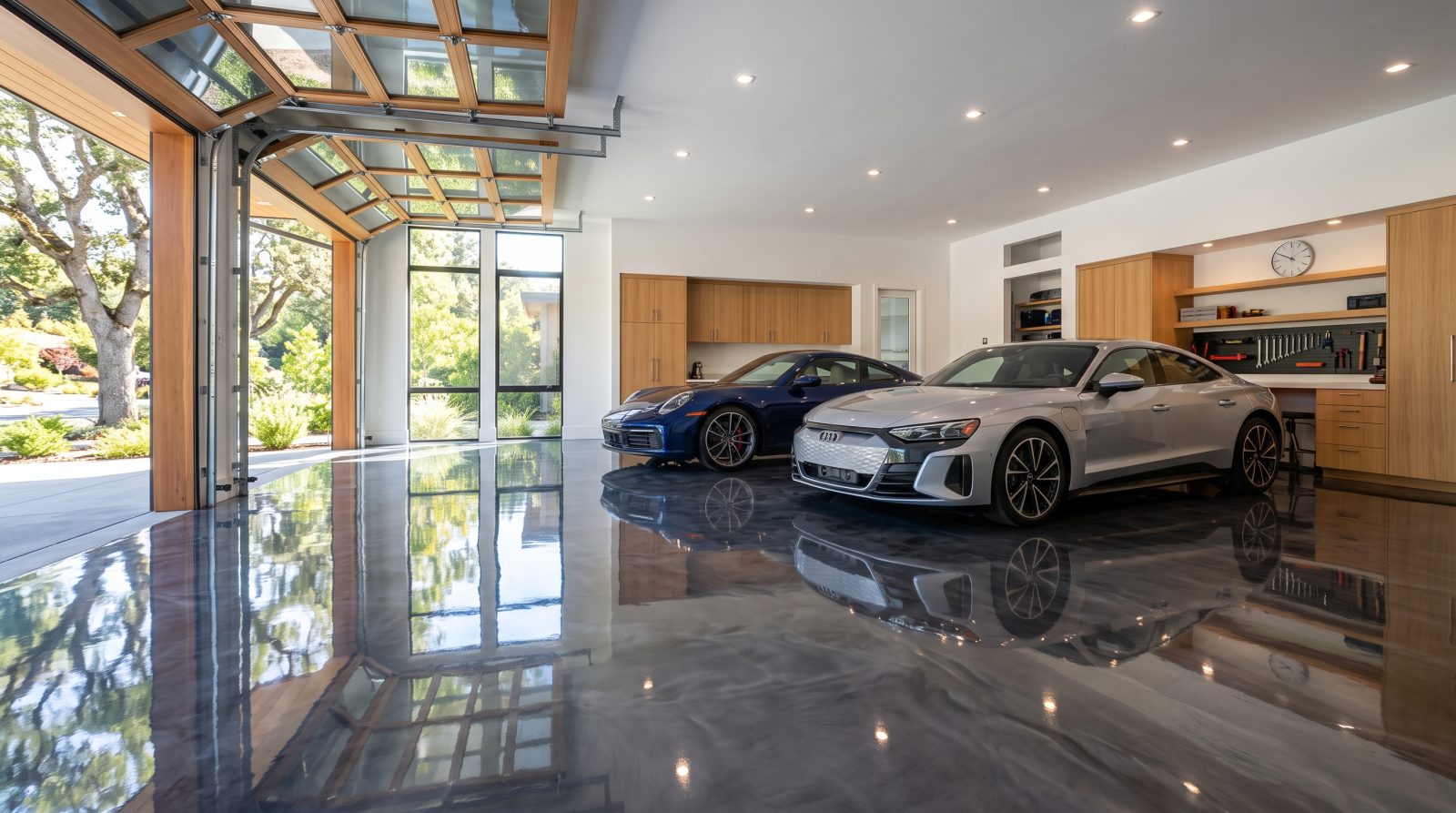
Why Campbell concrete needs the right floor coating
Campbell sits in the West Valley of the South Bay, between the Los Gatos Creek corridor and the flatter ground toward San Jose and Saratoga. The town blends mid-century ranch homes near the historic downtown and Campbell Park with newer infill construction and townhomes off Hamilton and Winchester. That range matters for floor coatings: an attached garage slab poured in the 1950s or 60s behaves very differently from a slab poured in the last fifteen years, and each needs a coating system matched to its age, surface profile, and moisture behavior.
The local climate is mild but not coating-neutral. Campbell gets warm, dry summers and a cool, damp rainy season from roughly November through March. Concrete that stays cold and damp through winter, then heats up in summer, expands and contracts and can drive moisture vapor up through the slab. A coating bonded to a slab that was never moisture-tested can blister, bubble, or peel later. This is a common reason a previous DIY or rushed epoxy job fails here, and it is largely preventable with proper testing and prep.
Homes near the Los Gatos Creek Trail and lower-lying parcels can have higher water tables and damper slabs, while hillside-adjacent lots toward the Los Gatos line tend to drain better. We assess every Campbell slab on its own evidence rather than assuming, which is why the prep stage drives the result far more than the brand of coating in the bucket.
What does epoxy or polyaspartic floor coating cost in Campbell?
Cost depends on your square footage, slab condition, and the system you choose, so any number you see online should be read as a typical range rather than a quote. For a standard two-car residential garage in the South Bay, full epoxy or polyaspartic floor-coating systems commonly fall in the low-thousands of dollars; larger spaces, heavy repair work, or premium polyaspartic top coats tend to sit higher. We provide a written estimate after seeing your floor in person.
Several Campbell-specific factors move the price. Older downtown-area slabs may need crack repair, pitting fill, or grinding to remove old paint or sealer before coating, which adds prep labor. Slabs with high measured moisture may need a moisture-mitigation primer, an added cost that protects the whole system. Larger metallic or full-flake decorative finishes cost more than a single-color base coat. Each of these is tied to making the coating last rather than added for its own sake.
- Costs shown anywhere on this site are typical ranges, not fixed or guaranteed pricing
- Slab prep (grinding, crack and pit repair, old-coating removal) is the most common cost variable on Campbell jobs
- Moisture-mitigation primer adds cost but guards against blistering on damper, lower-lying Campbell slabs
- Decorative full-flake and metallic finishes cost more than a single-color base coat
- A written estimate follows an on-site look at your actual floor
How we prep and coat a Campbell floor (step by step)
A coating is only as good as the concrete under it, so the process starts with diagnosis, not product. We inspect the slab, check for prior coatings or sealers, and run a moisture test before committing to a system. This matters in Campbell because a slab that reads high in moisture needs a different primer than a dry one, and skipping that step is a leading cause of early failure.
Surface preparation is done by mechanical grinding (diamond grinding or shot blasting), not acid etching alone. Grinding opens the concrete to a proper profile so the coating bonds into the surface instead of sitting on top of it. We then repair cracks and spalled or pitted areas, vacuum the dust, and apply the primer or base coat. Decorative flake or color is broadcast into the base, and a clear top coat seals everything. Cure times depend on the system and the weather, which is why a cool, damp Campbell winter day and a dry summer day are scheduled differently.
Throughout the job we keep the work area controlled and the surrounding garage protected. Coating chemistry is temperature- and humidity-sensitive, so we time application windows to the conditions on your slab that day rather than rushing to a fixed clock.
- Inspect the slab and run a moisture test before choosing a system
- Mechanically grind (diamond grind or shot blast) to a proper bonding profile
- Repair cracks, spalls, and pitting; vacuum all dust
- Apply primer/base coat, broadcast decorative flake or color, then seal with a clear top coat
- Schedule cure windows around the day's temperature and humidity, which vary across Campbell's seasons
Epoxy vs. polyaspartic: which suits a Campbell garage?
Both epoxy and polyaspartic coatings outperform bare or painted concrete, and many Campbell garage floors use them together: an epoxy or primer base for build and adhesion, with a polyaspartic top coat for speed and durability. The right choice depends on how fast you need the space back, how much UV the floor sees, and your budget.
Epoxy builds a thick, hard, chemical-resistant film and is a proven base layer, though pure epoxy can amber (yellow) over time where it gets direct sunlight, which is a consideration for garages that stand open to afternoon sun. Polyaspartic coatings cure faster, hold their color better under UV, and tolerate a wider temperature range during application, which is useful in Campbell's cool, damp winter months when slower epoxy cures can stall. The tradeoff is that polyaspartic systems typically cost more.
For a typical attached Campbell garage that you want back in service quickly and that may see some sunlight through an open door, a hybrid system, an epoxy or primer base under a polyaspartic top coat, is often the most balanced choice. We match the system to your floor and how you actually use the space rather than defaulting to one product.
- Epoxy: thick, hard, chemical-resistant base; can amber under direct sun over time
- Polyaspartic: faster cure, better UV color hold, wider application temperature range; typically higher cost
- Hybrid (epoxy/primer base + polyaspartic top coat): balances build, durability, and fast return to service
- Best pick depends on sunlight exposure, how fast you need the garage back, and budget
Serving Campbell and the West Valley
We coat floors throughout Campbell and the neighboring South Bay and West Valley communities, including the areas around downtown Campbell, the Pruneyard, and the Winchester and Hamilton corridors, as well as nearby Los Gatos, Saratoga, Cambrian Park, and West San Jose. Most of our Campbell work is residential garage floors, but we also coat patios, basements, workshops, and small commercial and retail floors.
Because Campbell mixes older established neighborhoods with newer townhome and infill construction, no two jobs are identical, and we plan each one around your specific slab and schedule. If you are weighing a coating for a garage, a covered patio, or a shop floor in Campbell, the best next step is a look at your concrete so we can recommend a system and give you a written estimate. Call us to set that up.