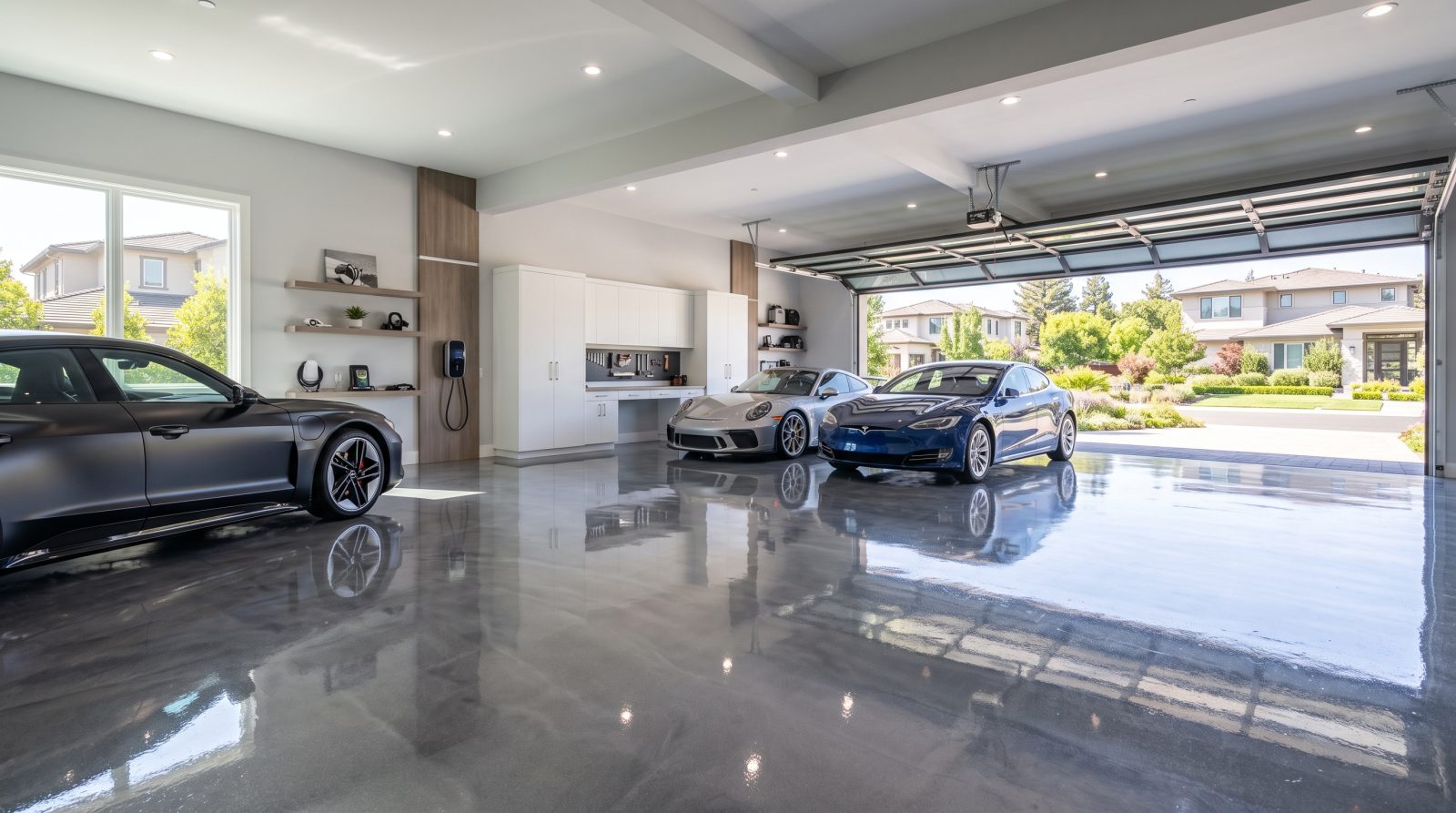
Why epoxy and polyaspartic coatings make sense for Santa Clara floors
Santa Clara sits in a mild Mediterranean climate: warm, dry summers and cool, damp winters, with very little of the freeze-thaw cycling that wrecks concrete in colder states. That's good news for a coating, because the main enemy here isn't ice — it's moisture vapor moving up through the slab, hot tires baking against the floor in a closed garage, and the everyday grind of oil, dropped tools, and grit. A bonded resin coating addresses all three: it seals the surface against vapor and stains, resists hot-tire pickup far better than a peel-and-stick mat or a hardware-store roll-on kit, and turns a dusty, porous slab into a surface you can sweep or mop clean.
There's a coastal wrinkle worth naming. The South Bay's marine layer pushes morning fog and humidity inland, and an attached garage that stays closed can trap that damp air against a cool slab. On bare or poorly sealed concrete, that shows up as a slightly damp floor, efflorescence (white powdery mineral deposits), or musty smell. A properly prepped and coated floor doesn't have open pores for that moisture to wick into, which is one reason homeowners often notice a cleaner, drier-feeling garage after coating.
The trade-off to understand: coatings only perform as well as the prep and the slab underneath them. A coating system is not a fix for a slab with active moisture intrusion or structural cracking — those need to be diagnosed and addressed first. That's why an honest installer tests and inspects before quoting, rather than promising a finish over any floor sight-unseen.
- Resists hot-tire pickup, oil, brake fluid, and most household chemicals
- Seals porous concrete against vapor, dusting, and efflorescence
- Easy to sweep or damp-mop — no more grinding grit into the slab
- Decorative flake or quartz options add slip resistance and hide minor imperfections
What kinds of Santa Clara floors and homes do you coat?
Santa Clara's housing stock is varied, and the right approach changes with the slab. A lot of the city is postwar and mid-century: ranch homes and tract houses built from the 1940s through the 1970s, including pockets of Eichler-style homes. Those garages tend to have older slab-on-grade concrete that may show cracks, prior patches, oil saturation from decades of use, or a sealer or paint someone applied years ago. All of that has to be read correctly and prepped — old coatings ground off, oil-saturated spots treated, cracks chased and filled — before a new system will bond.
Newer construction tells a different story. Townhome and condo garages around Rivermark, Santa Clara Square, and the developments near Levi's Stadium and the former Agnews area often have tighter, smoother, more recently poured slabs. Those can be excellent candidates, but freshly poured concrete needs to cure — typically around 28 days — and still gets moisture-tested before coating. We also coat patios, walkways, basements and storage rooms, and light-commercial floors such as shops, warehouses, and back-of-house areas for South Bay businesses.
Because we inspect before quoting, the recommendation is matched to your floor rather than sold off a one-size menu. A clean newer garage might be a straightforward flake system; an old, oil-stained ranch garage might need extra prep and crack work to get a result that lasts.
- Mid-century and ranch garages near Santa Clara University and the older grid neighborhoods
- Newer townhome and condo garages around Rivermark and Santa Clara Square
- Patios, walkways, and entry slabs exposed to the marine-layer damp
- Light-commercial and shop floors for South Bay businesses
How the coating process works, step by step
A coating that lasts is mostly about what happens before the color goes down. The first real step is surface profiling — we mechanically grind the concrete with diamond tooling (not acid-etching alone) to open the pores and create the texture the resin needs to bond. Skipping or shortcutting this is the single most common reason a previous coating peeled, and it's worth asking any contractor how they prep.
Next comes assessment and repair: moisture testing to confirm the slab is dry enough to coat, then filling cracks, spalls, and pits and treating any oil-contaminated areas so the new system bonds evenly. Only then do we apply the coats. A typical garage system is a primer or base coat, optional decorative vinyl flake or quartz broadcast for grip and looks, and a clear topcoat — often a polyaspartic or polyurethane — that carries the abrasion and UV resistance.
Cure times depend on the chemistry and the weather. As a general guide, epoxy base coats commonly need around 24 hours before foot traffic and several days before vehicle traffic, while polyaspartic topcoats cure faster and can shorten the timeline. Santa Clara's mild temperatures are forgiving, but cool, foggy winter mornings raise humidity and lower slab temperature, which can extend cure times — so we schedule and stage the work around real conditions rather than a fixed promise.
- Diamond-grind the slab to a proper profile (the foundation of adhesion)
- Moisture-test and repair cracks, spalls, and oil-stained zones
- Apply base coat, optional flake or quartz, and a durable clear topcoat
- Respect real cure windows — roughly 24 hrs to walk, several days to drive
What does an epoxy floor coating cost in Santa Clara?
Honest answer first: the only accurate number is one tied to your actual floor, so treat anything below as a typical industry range and an estimate, never a quote. As a rough planning guide, professionally installed garage floor coatings in markets like the Bay Area commonly fall somewhere in the range of about $4 to $10-plus per square foot depending on the system, with full polyaspartic or quartz builds landing toward and above the high end and basic single-coat systems toward the low end. For a standard two-car garage that's a wide spread, which is exactly why a walkthrough matters.
The biggest cost drivers are prep and slab condition, not the color. An older Santa Clara ranch garage with heavy oil saturation, multiple cracks, or a failing previous coating needs more grinding, repair, and labor than a clean newer townhome slab — and that prep is where durability is won or lost. Other factors include square footage, the system you choose (single-color epoxy vs. full flake vs. metallic vs. quartz), how much grip and chemical resistance you need, and whether the floor needs moisture mitigation.
What you should expect from any reputable installer is a clear, itemized estimate after they've seen the floor, with the prep and system spelled out — not a fixed price quoted over the phone before anyone has looked at the concrete. Call to set up a look at your slab and we'll walk you through realistic options and ballpark numbers for your situation.
- Typical industry range (estimate): roughly $4-$10+ per sq ft installed, depending on system
- Prep and slab condition usually move the price more than the color choice
- Polyaspartic, metallic, and quartz systems sit toward the higher end
- Real numbers come from a walkthrough — not a phone quote
Choosing a Santa Clara floor-coating installer
Coatings are a craft, and the difference between a floor that lasts and one that peels in a season comes down to a few questions you can ask up front. First, ask how they prep: the answer should be mechanical diamond grinding, not acid-etch-only or a quick scuff. Second, ask whether they moisture-test before coating — skipping that step over a damp South Bay slab is how coatings delaminate. Third, ask what they actually do with cracks and oil stains, because covering them instead of repairing them just hides a future failure.
It's also fair to ask about the system and the timeline in plain terms: what product goes down, how many coats, what the topcoat is, and roughly how long until you can walk and drive on it. A straight answer that accounts for weather is a good sign; a one-size, same-for-every-floor pitch is not. We aim to give you that clarity before you commit — an inspection, an explanation of what your slab needs, and an estimate you can actually understand.
If you're weighing options across Santa Clara and the wider South Bay, the right next step is simply a conversation about your specific floor. Call to talk through your garage, patio, or shop slab, and we'll tell you honestly what it needs and what it doesn't.
- Confirm they mechanically grind — not acid-etch alone
- Ask if they moisture-test before coating
- Make sure cracks and oil stains are repaired, not just covered
- Expect a clear, written estimate after they see your floor