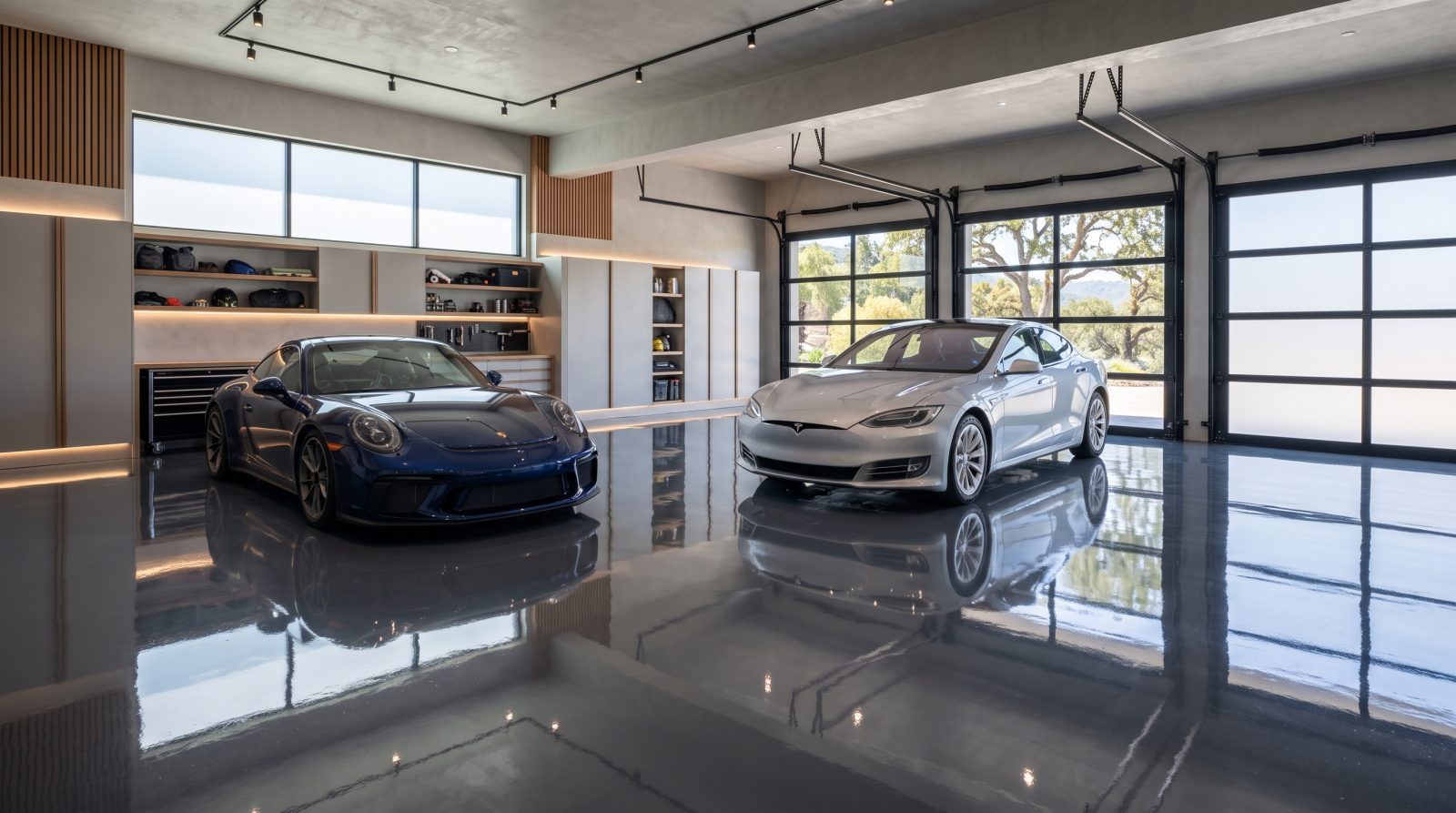
Why San Jose garage floors need a coating built for the local slab
Most San Jose homes sit on slab-on-grade foundations poured directly over Santa Clara Valley soil, and a lot of that soil is expansive clay (adobe) that swells when wet and shrinks as it dries. Over the years that movement, plus normal concrete shrinkage, leaves the hairline cracks and minor lippage you see in older Willow Glen, Cambrian, and Berryessa garages. A coating system won't fix a structural problem, but a properly prepped epoxy or polyaspartic floor bridges minor surface cracks, fills pinholes, and gives you a single sealed surface that's far easier to keep clean than bare, porous concrete.
The local housing stock also shapes the job. Eichler and mid-century ranch homes from the 1950s and 60s often have thinner, older slabs with a smooth troweled finish that needs aggressive mechanical profiling to bond properly. Newer tract garages in Evergreen, Almaden, and North San Jose tend to have denser, hard-troweled concrete that also resists adhesion unless it's ground first. In both cases, grinding rather than acid etching alone is what gives a coating something to grab onto.
Bare concrete in a valley garage takes a beating: hot tires pulling onto the slab on a 90-plus-degree afternoon, oil and brake dust, and grit tracked in from gravel driveways and weekend trips up to the Sierra. A sealed, abrasion-resistant floor turns that daily wear into a quick sweep or hose-down.
Does San Jose's climate affect epoxy installation?
Yes, and mostly in your favor. San Jose's Mediterranean climate gives long stretches of warm, dry weather from late spring through early fall, which is close to ideal for coating concrete. Epoxy generally cures best when the slab and air stay roughly between 55 and 90 degrees Fahrenheit with relative humidity under about 70 to 80 percent, and most San Jose summer days sit comfortably in that range. That's why the dry season is the easiest time to schedule a clean, predictable cure.
Winter is workable too, but it changes the plan. Cooler, damper months mean slower cure times, and a slab that sat through the rainy season can hold more moisture than it looks. That's where polyaspartic coatings earn their keep: they typically cure faster and tolerate a wider temperature range than traditional epoxy, so a properly prepped floor can often be back in service in about a day even in cooler weather. We test slab moisture before committing to any system rather than assuming a dry-looking floor is actually dry.
- Dry season (roughly May to October): the easiest cure window, full epoxy systems schedule well
- Wet season: moisture testing matters most, and polyaspartic top coats handle cooler, faster turnarounds
- We check concrete moisture and surface temperature on site, not by the calendar alone
What coating systems we install across San Jose
There's no single right floor for every home; the best system depends on how you use the space and how the slab tests. For most residential garages we recommend a full-flake (broadcast chip) system: an epoxy base coat, decorative vinyl flakes broadcast to refusal, and a clear polyaspartic or polyurethane top coat for UV and abrasion resistance. That build typically runs in the range of 18 to 30 mils thick depending on the system, and the flake hides minor slab imperfections while adding traction.
For workshops, fleet bays, and commercial floors that take heavier loads or forklift traffic, we step up to a higher-build epoxy, or a metallic system where the look matters. For homeowners who want the fastest return to service, a one-day polyaspartic system is often the answer. We'll walk you through the trade-offs in plain English so you can choose based on your budget and how hard the floor gets used, not on a sales script.
- Full epoxy flake systems for residential garages (durable, slip-resistant, hides minor flaws)
- Polyaspartic and one-day systems for fast turnaround and cooler-weather installs
- Metallic and high-build epoxy for showrooms, shops, and statement floors
- Patios, basements, laundry rooms, and light commercial slabs
Our preparation and cure process, step by step
Coating failures almost always trace back to skipped prep, not bad product. Our process starts with inspecting and moisture-testing the slab, then diamond-grinding the surface to a proper concrete profile (typically CSP 2 to 3) so the coating bonds mechanically instead of just sitting on top. We chase and fill cracks and spalls, repair pitting, and vacuum the dust before any coating goes down.
From there we lay the base coat, broadcast flake if you've chosen a flake system, scrape and recoat as needed, and finish with the clear top coat. Cure times depend on the system and the weather: a flake floor is usually walk-on ready in roughly 12 to 24 hours and ready for vehicle traffic in about 24 to 72 hours, while many polyaspartic builds compress that timeline to around a day. We give you specific timing for your job before we start, along with simple aftercare so the finish lasts.
- Inspect the slab and run a moisture test before quoting a system
- Diamond-grind to open the concrete (CSP 2 to 3 profile)
- Repair cracks, spalls, and pitting, then a full vacuum cleanup
- Base coat, flake or metallic media, then a UV-stable clear top coat
- Walk-on in about 12 to 24 hours, vehicles in roughly 24 to 72 hours depending on system
San Jose neighborhoods and surrounding areas we serve
We coat floors throughout San Jose and the wider South Bay, including Willow Glen, Almaden Valley, Cambrian Park, Rose Garden, Naglee Park, Berryessa, Evergreen, Silver Creek, North San Jose, and Santa Teresa. We also serve neighboring Santa Clara Valley cities such as Santa Clara, Campbell, Cupertino, Saratoga, Los Gatos, Milpitas, and Sunnyvale.
Because so much of the area shares the same slab-on-grade construction and valley clay soils, the prep approach is similar from neighborhood to neighborhood, but every slab is different. We always walk your specific floor before recommending a system. If you're not sure whether we cover your street, just call and ask.