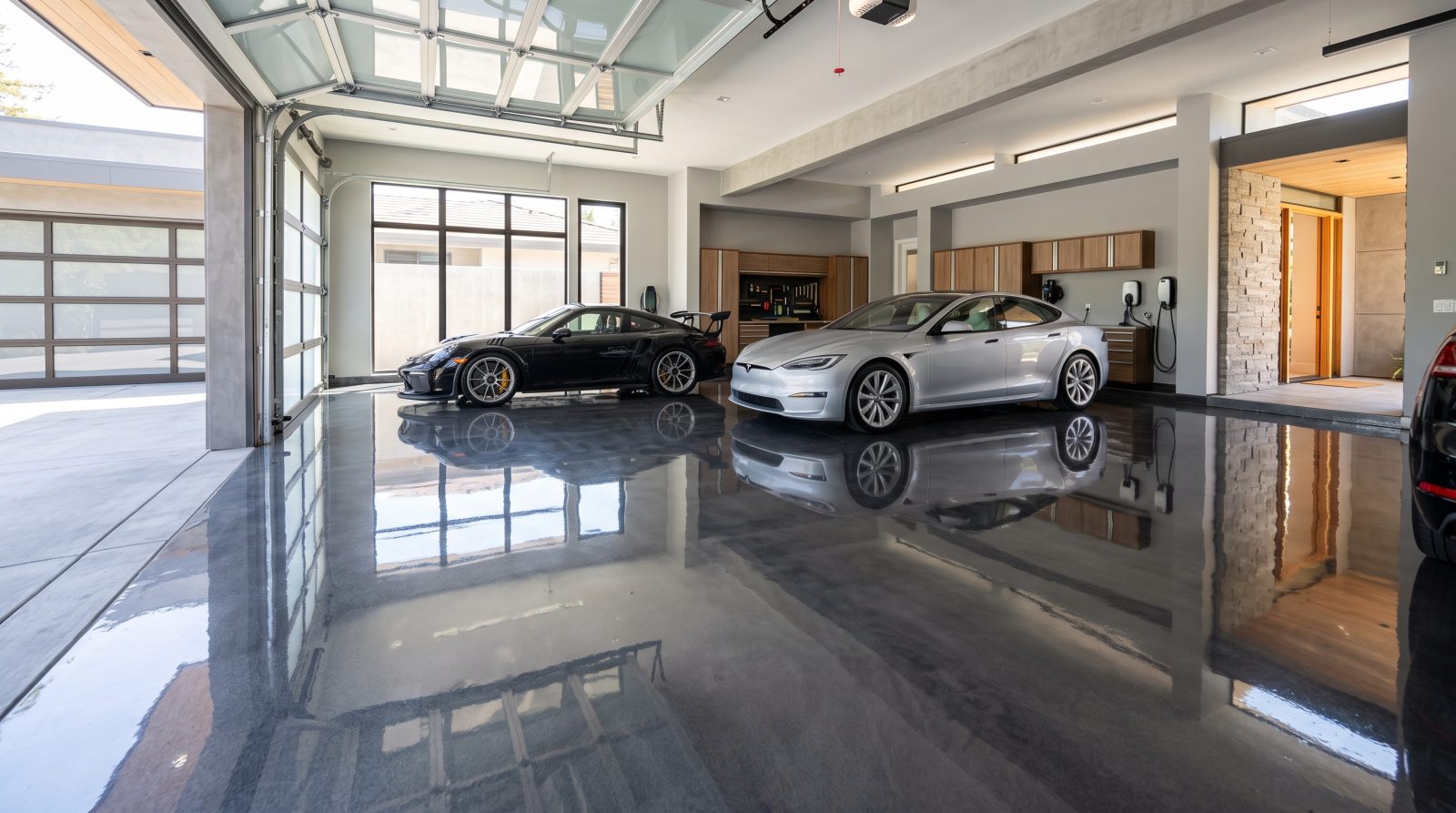
Why Mountain View floors need the right coating system
Mountain View sits in the South Bay between the Bay shoreline and the foothills, and that location shapes what your concrete actually deals with. Mild, marine-influenced air means relatively little freeze-thaw damage, but it also means higher ambient humidity and slabs that can hold moisture, especially in homes closer to the bay-flat neighborhoods near Shoreline and the older Old Mountain View grid. Moisture moving up through a slab is one of the most common reasons a cheap coating peels, so we test and prep for it rather than coating over a problem.
The housing mix here runs from postwar single-story ranch homes in neighborhoods like Monta Loma and Rex Manor to newer townhomes and condos near downtown and the North Bayshore corridor. Many of those mid-century garages have original concrete that is now decades old: hairline cracks, oil staining from years of parking, and a troweled finish that is too smooth for a coating to grip without mechanical profiling. A floor that earns a long life starts with reading the slab honestly, not with the color you pick.
Daytime temperatures in Mountain View stay generally moderate year-round, which helps resin coatings because epoxy and polyaspartic both cure within set temperature and humidity windows. We schedule and select products around the real conditions on your install day rather than assuming a perfect lab environment.
What we coat in Mountain View homes and shops
We focus on concrete floor coatings for residential and light-commercial spaces around Mountain View. The goal is a surface that wipes clean, shrugs off the things that ruin bare concrete, and looks finished rather than industrial.
- Garage floors, from single-car ranch garages to multi-bay and tandem garages in newer builds
- Patios, walkways, and covered outdoor concrete where slip resistance matters
- Basement and ground-floor utility areas that need a sealed, dust-free surface
- Workshops, home gyms, and hobby spaces where dropped tools and rolling loads are common
- Light-commercial floors such as back-of-house retail, studios, and service bays
Our coating options: epoxy, polyaspartic, and flake systems
The right system depends on how you use the space and how fast you need it back. We walk you through the trade-offs in plain English rather than pushing one product.
Standard epoxy builds a thick, hard film that bonds well to properly prepped concrete and gives a durable base. Epoxy can be sensitive to UV over time, so for sun-exposed patios or door openings we often pair or top it with a UV-stable layer. Polyaspartic, a coating in the polyurea family, cures faster, handles temperature swings well, and resists UV yellowing, which is why it is popular as a fast-return garage topcoat. A decorative flake (chip) broadcast system adds a textured, speckled finish that hides minor imperfections and improves traction.
A common high-performance build is an epoxy base coat, a full broadcast of decorative flakes, and a clear polyaspartic or polyurethane topcoat. That stack gives you the bond and build of epoxy, the look and grip of flake, and the durability and faster cure of a polyaspartic top layer.
- Solid-color epoxy: clean, uniform base for protected interior floors
- Flake (chip) systems: textured and decorative, hides blemishes, adds slip resistance
- Polyaspartic topcoats: fast cure, UV-stable, strong abrasion and chemical resistance
- Metallic and specialty finishes: available for living spaces and showroom-style floors
How we prep and install (and why prep decides everything)
A floor coating is only as good as the surface under it, so the most important step happens before any resin is opened: mechanical preparation. On Mountain View garages we typically diamond-grind the concrete to remove old sealers, laitance, and the slick troweled top layer, opening the pores so the coating can lock in. We grind rather than acid-etch because grinding gives a more consistent profile on the dense, aged slabs common here.
From there we route and fill cracks and control joints, patch spalled or pitted areas, and address oil contamination, which is common in long-used garages and must be pulled out before coating or it will cause adhesion failure. Where slab moisture is a concern, we test and, if needed, use a moisture-mitigating primer so vapor pressure does not push the coating off later.
Then we apply the chosen system in coats, broadcasting flakes if your finish calls for it, and finish with the topcoat. Cure times depend on the product: many polyaspartic topcoats are walk-on within hours and ready for vehicle traffic in roughly a day or two, while full-epoxy systems generally want a longer cure before hot tires return. We give you the specific cure schedule for your floor so you are not guessing about when to move back in.
Coating film thickness is measured in mils (thousandths of an inch), and a real coating system is meaningfully thicker than a bargain roll-on kit. We tell you the build we are installing and what that means for durability so you can compare estimates on equal terms.
Local service area and what a project typically costs
We serve Mountain View and the surrounding South Bay and Peninsula, including neighboring Sunnyvale, Los Altos, Palo Alto, Cupertino, and Santa Clara, along with Mountain View neighborhoods such as Old Mountain View, Cuesta Park, Monta Loma, Rex Manor, Whisman, and the Shoreline and North Bayshore areas.
Pricing depends on square footage, the condition of your existing slab, how much crack and oil repair is needed, and which coating system you choose. As a rough planning guide only, professionally installed garage floor coatings in the Bay Area typically fall somewhere from a few dollars to several dollars per square foot, with full flake-and-polyaspartic systems and heavy repair work landing toward the higher end. Those numbers are typical ranges for budgeting, not a quote. The honest way to price your floor is to look at it, so we provide a free on-site estimate with a clear written scope before any work begins.
- Free, no-pressure on-site estimate with a written scope of work
- Honest assessment of slab condition, moisture, and prep needs before we quote
- Plain-English explanation of system options and realistic cure timelines